Click here to sign up for our free daily newsletter.
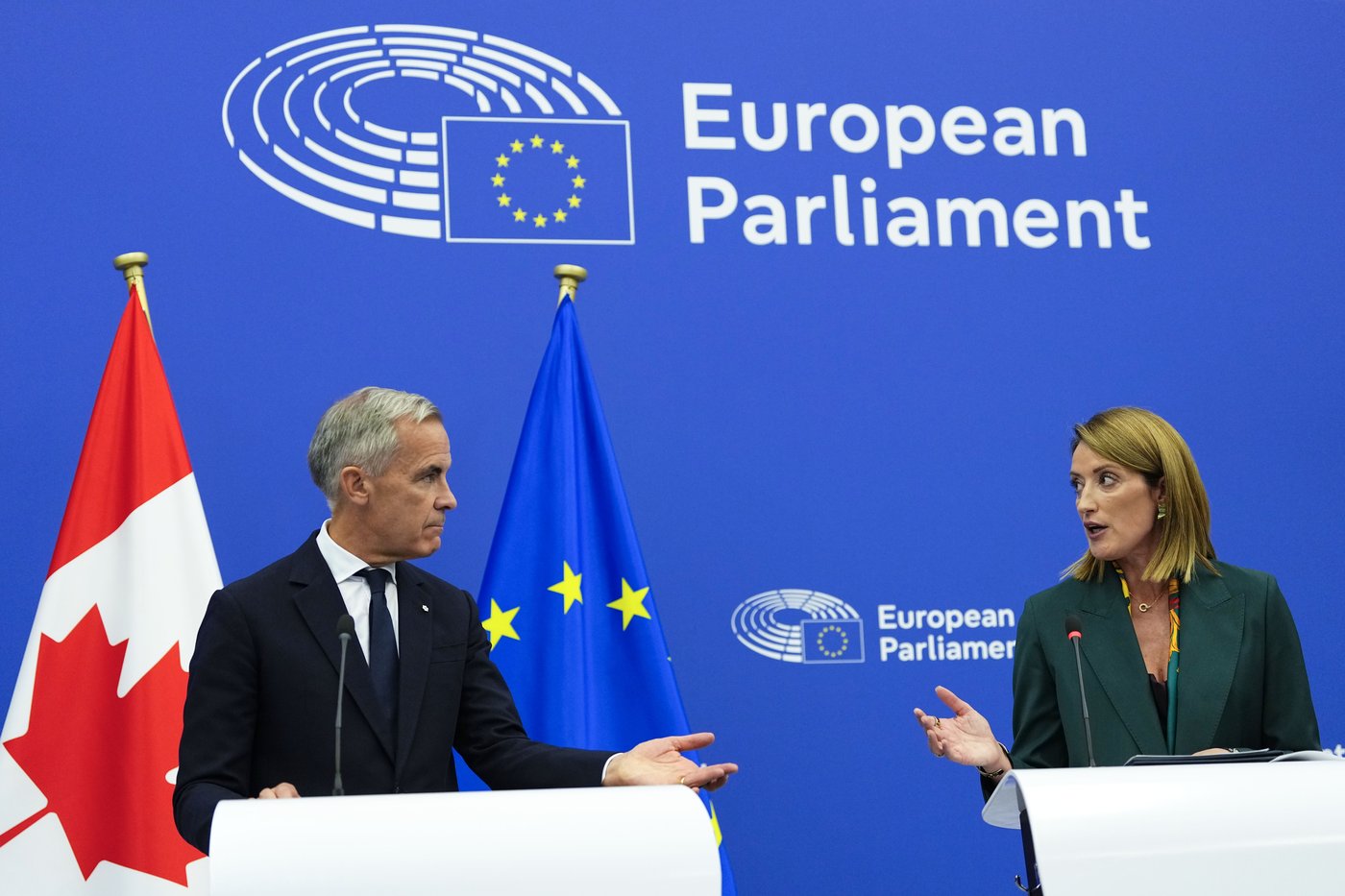
Prime Minister Mark Carney and President of the European Parliament Roberta Metsola participate in a joint news conference at the European Parliament in Strasbourg, France, on Thursday, Sept. 17, 2026. THE CANADIAN PRESS/Justin Tang

How the European Union works with other countries — and what that means for Canada

Sep 17, 2026 | 3:20 PM

OTTAWA — Canadian and European Union leaders say their proposed alliance could deliver long-term benefits to both sides, along with some more immediate advantages.

Here’s a look at what non-EU countries have arranged with the bloc, and what Canada could get.

In the near term

Prime Minister Mark Carney says Canadian youth could enjoy more freedom to work and study in Europe. That measure likely would also make it easier for young Europeans to come to Canada.

Canada and European countries already have university exchanges. But Canada could join the EU’s Erasmus program, which might enable Canadians to study in Europe for more than a single year and might make them eligible for grants.

If the EU’s Erasmus arrangement with Canada is similar to its arrangements with other countries, those grants would come from money that Ottawa itself would contribute.

Canadian researchers might also be allowed to work more closely with their European counterparts. Canada is eligible for EU grants to work with European colleagues under a research partnership called Horizon. Canada could join a new fund to replace that program, which some call FP10.

Jonathan Wilkinson, Canada’s incoming ambassador to the European Union, said any new labour mobility programs would be limited and would require consultation with the provinces.

In the long term

Most of what Carney and his European counterparts discussed this week in France was related to projects that could take years to yield results.

Many of those projects are in strategic sectors such as artificial intelligence, quantum technology and cybersecurity.

European Parliament President Roberta Metsola said Thursday the partnership could touch on everything “from critical raw materials, energy and connectivity to AI, education, defence and the Arctic region.”

Carney said Thursday that Canada can work with Europe on “strategic autonomy,” which he said means access to things like semiconductors, payment systems, clean energy and space communications that doesn’t rely on the goodwill of superpowers. That echoes remarks he delivered in Australia this past March.

Industry Minister Mélanie Joly said Wednesday in Toronto that talks with Brussels could seek to ensure that Canada is not cut out of steel and aluminum trade with Europe in the event the EU acts to protect its industries from foreign tariffs.

Already strong ties

Ottawa and Brussels already have a free trade deal, though 10 of 27 EU countries haven’t ratified it. Canada and the EU also have a strategic partnership agreement, a scientific research pact and a defence-industrial arrangement.

EU Ambassador to Canada Geneviève Tuts said the proposed new partnership is about getting the full benefit of all those arrangements.

“It’s more than filling gaps,” Tuts said last week.

“The idea is to go further in the integration, on substance and on the way we are working together. So the first reflection will be on substance. What do we want to do together? Where do we want to co-operate more? And the second part will be how to do that, in what sort of format. This will be for later.”

What does Norway have?

Like Canada, Norway is a northern nation with oil wealth, green aspirations, Indigenous populations, NATO membership and close ties with Europe.

For three decades, the country has had a deal with EU that gives both sides free access to each other’s markets for goods and services, and gives Norway access to most EU programs. But Norway does not help to set the EU rules that it has to follow.

In exchange for not having a vote on EU regulations, Norway’s fishing and oil extraction sectors are free from control by Brussels.

Both Liechtenstein and Iceland have the same terms in their arrangements with the EU. Iceland voted last month against joining the EU, largely over concerns about the fishing industry.

What about Switzerland?

Neutral Switzerland has much more limited ties with the EU through dozens of treaties, instead of one overarching agreement.

In practice, that means Switzerland gets many of the same things Norway does, such as Erasmus student exchanges and financial regulation — but its access to those services is often slower and more narrow.

Post-Brexit talks

The United Kingdom left the EU in 2020 but remains a key partner in Europe’s defence and supporting Ukraine’s fight against Russia’s war.

London and Brussels have held talks on ways to work together on things like climate change and defence. British governments have recently signalled a desire for closer ties.

But the idea of harmonizing regulations or fishing rules with those on the continent remains politically sensitive in the U.K.

This report by The Canadian Press was first published Sept. 17, 2026.

Dylan Robertson, The Canadian Press