Click here to sign up for our free daily newsletter.
The Madden Fire status is 'protecting values' and is located just north of Denare Beach. (Image Credit: Facebook/SPSA)
Wildfires near Southend

SPSA reports no evacuations as lightning-sparked fires burn near northern communities 

Jun 30, 2026 | 2:02 PM

The Saskatchewan Public Safety Agency (SPSA) said there are no current evacuations in the province, but officials are working with several northern communities as wildfire activity increases and smoke affects residents. 

As of 9:30 Tuesday morning, the SPSA reported 56 active wildfires across Saskatchewan. Seven were listed as contained, three were not contained, 36 were under ongoing assessment, and 10 were classified as protecting values. Forty-one fires have started or been reported in the past week, while 12 have been declared out. 

SPSA president Marlo Pritchard said the province has seen an increase in wildfire starts recently, but periods of rain and work by local communities and fire crews have helped limit damage. 

There have been 192 wildfires so far this year, which Pritchard said is below the five-year average of 222 and below the 309 reported by this time last year. 

“We are not currently aware of any evacuations,” Pritchard said, adding the agency is in contact with Peter Ballantyne Cree Nation, the Prince Albert Grand Council and the communities of Sandy Bay, Southend and Wollaston Lake. 

He said SPSA staff are supporting local planning in case evacuations become necessary, and are also looking at air shelters and supports for priority residents with health concerns if smoke conditions worsen. 

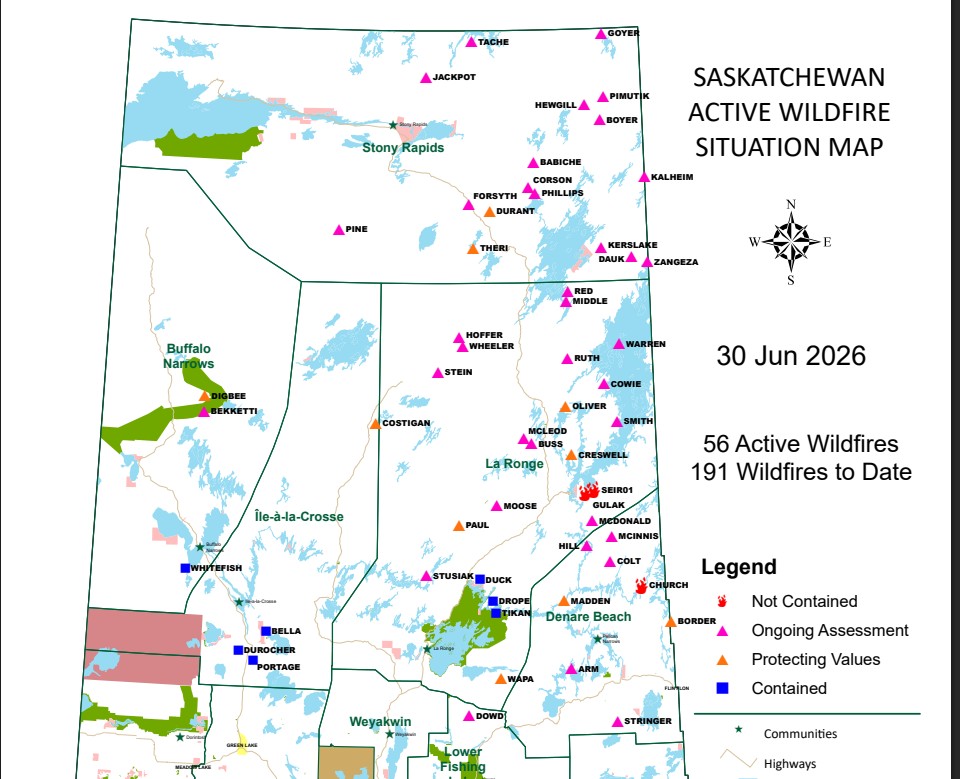
Brian Chartrand with the SPSA said several fires are being watched closely near northern communities. East of Southend, the Gulak fire is about 20 hectares and roughly 12 kilometres from the community. Another nearby fire, SEIR 01, is about 2,500 hectares and roughly 16 kilometres east of Southend. 

Right now, Saskatchewan's wildfires are concentrated in the northeast quarter of the province.
Right now, Saskatchewan’s wildfires are concentrated in the northeast quarter of the province. (Image Credit: screenshot/SPSA website)

Crews have established helipads, started building fire lines and completed a backburn operation on SEIR 01 to help hold the blaze within natural barriers such as lakes, rivers and rock areas. 

Chartrand said conditions around Southend have improved since Sunday, when one of the fires was taking “a major run,” and representatives are in the community speaking with leadership about contingency plans, smoke supports and values protection. 

“With any fire, there’s always concern. Things change rather quickly,” Chartrand said. “But again, conditions have improved. We’re getting more and more resources there.” 

The McDonald fire, south of Southend, is also about 2,500 hectares and approximately 22 kilometres from the community. Chartrand said forecast winds are not currently pushing that fire toward Southend, but crews are watching it for possible containment opportunities. 

Near Sandy Bay, the Church wildfire has so far charred 12 hectares and is 3.5 kilometres from the community. Chartrand said crews are making good progress and do not anticipate major challenges.

The Border fire, north of Creighton and Flin Flon and southeast of Sandy Bay, is estimated at 9,100 hectares. It is burning mostly on the Saskatchewan side but crosses into Manitoba. Officials said it is not threatening communities, though values protection is underway for cabins and lodges. 

North of Wollaston Lake, the Curse Lake fire is about 21 hectares and roughly 19 kilometres from the community. Chartrand said northeast winds could slowly move the fire in that direction, but water bodies and other natural features give crews opportunities to stop its spread. 

Smoke in the La Ronge area Monday was likely from Saskatchewan fires, Chartrand said. He pointed to a cluster of lightning-caused fires northeast of La Ronge and around Southend, with northeast winds pushing smoke into the area. 

Officials said lightning has been the main cause of the current wildfire activity in the north. Thirty fires this season have been confirmed as lightning-caused. 

Pritchard also addressed recent reviews of the province’s 2025 wildfire response, including reports from the provincial auditor and MNP. He said he will not step down as SPSA president and will lead changes identified in the reviews. 

Pritchard said the agency has created a future preparedness unit and has already made changes to internal documentation, communication processes, support for evacuees and the way financial assistance could be delivered during evacuations. 

The SPSA has also escalated the Provincial Emergency Operations Centre to support the increase in fire activity. 

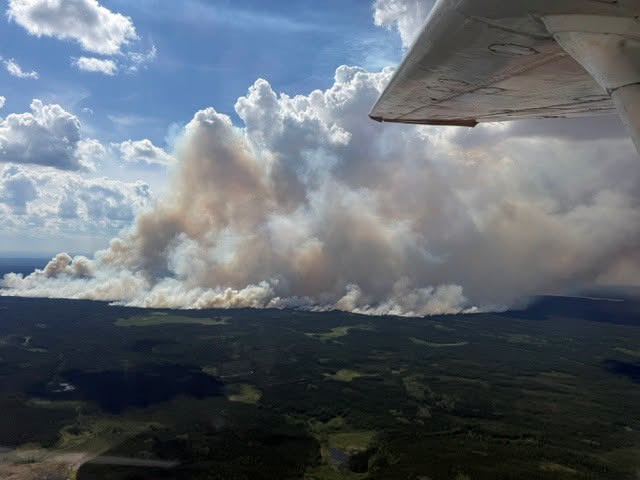
The McInnis fire, south of Southend, is approximatley 4,700 hectares in size and was ignited by lightning.
The McInnis fire, south of Southend, is approximatley 4,700 hectares in size and was ignited by lightning. (Image Credit: SPSA/Facebook)

Two provincial water bombers remain under repair, while another is receiving maintenance and is expected to return to service shortly. Pritchard said Saskatchewan has received four 802 skimmers and a bird dog aircraft from New Brunswick through mutual aid, and the federal Q400 is also in the province to support air operations.

On flooding, Pritchard said the agency has responded to five incidents earlier this year and is aware of a high-flow water advisory from the Water Security Agency. However, he said there are currently no new requests for SPSA flood support. 

Chartrand said some flood files remain active because equipment such as pumps, hose, sandbags and sandbaggers are still in place as a precaution, but there are no active flooding events currently impacting communities. 

susan.mcneil@pattisonmedia.com