Click here to sign up for our free daily newsletter.
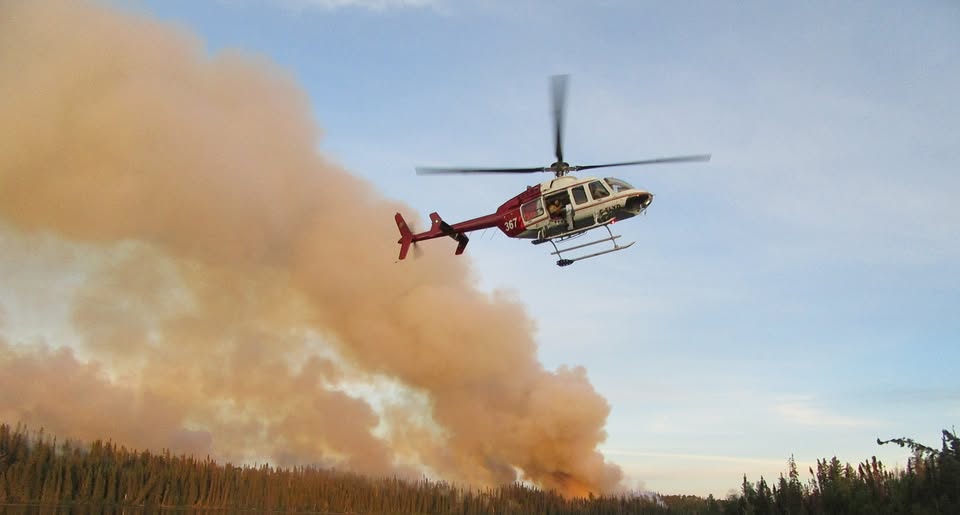
CRCC Wildfire returned to their own base following a deployment to the Shellbrook and Duck Lake areas in support of the SPSA. The province reported minimal growth on the wildfire that was caused by lightning on Tuesday, May 26, 2026. (Image Credit: CRCC Wildfire Saskatchewan/Facebook)
Holding the line

Crews gain ground on wildfires as debate continues over fire ban response

Jun 1, 2026 | 3:43 PM

The province is sitting in a much better position than it was over the weekend when it comes to wildfires.

At a media briefing Monday morning, executive director of land operations for the Saskatchewan Public Safety Agency (SPSA) Bryan Chartrand and Premier Scott Moe said huge efforts by local governance organizations, rural municipalities, volunteers, local fire departments and the SPSA have kept homes on both sides of the North Saskatchewan River safe from the Lobstick wildfire, which has so far charred nearly 19,000 hectares.

“There’s been a significant effort both in the north and south side of the river to build up our fire protection on the eastern flank of that fire,” said Moe. “Should the wind shift and start to come from a more traditional way – the westerly winds – that we wanted to prevent this fire ever having the opportunity to take a run, as it has ample fuel alongside the river as it heads up to Prince Albert.”

Only a chicken coop, a shed and an old unoccupied trailer have been lost to the fire. About 130 residents from the RM of Shellbrook remain evacuated and some horses and cattle were also moved.

While the Lobstick fire is the largest wildfire burning in the province, the Cayford fire in the northeast has displaced the most number of people. About 1,300 people were forced to leave Red Earth and Shoal Lake Cree Nation, largely due to excess smoke.

Chartrand said while conditions are still extreme, some precipitation fell on the fire that currently measures 11,500 hectares in size, and that assisted with suppression efforts and prevented the fire from heading north towards Highway 55.

“That did give us good operational period to establish lines, get dozer lines in and bolster our response. So, we experienced very minimal growth to the fire yesterday,” Chartrand said.

“We’re not predicting the fire to impact any other communities other than perhaps smoke, depending on the wind conditions.”

Containment lines are holding and cooler temperatures and precipitation are in the forecast, but various contingency plans are in place if firefighters continue to be challenged. He said an incident management team, with highly experienced and trained personnel, are being briefed on the Cayford wildfire.

“You never know…things change quickly in this business, but things are looking very favourable at the moment,” Chartrand said.

The size of the Cayford fire in northeast Saskatchewan was approximately 11,500 hectares, on June 1, 2026.
The size of the Cayford fire in northeast Saskatchewan was approximately 11,500 hectares, on June 1, 2026. (Image Credit: SPSA/Facebook)

In the case of both fires, crews have been using natural barriers like lakes to control the flames.

There are currently 9 active wildfires in the province; there have been 88 to date.

Fire ban process under scrutiny

A common complaint from those affected by wildfires, whether this year or last, has been a lack of communication and coordination between the SPSA and local officials.

The Reeve for the RM of Duck Lake, Remi Martin, has been critical of the provincial government for taking too long to put a provincial fire ban in place.  The Nisbet forest, where the Lobstick fire started, runs through the rural municipality. He’s been pushing the government to put that section of the provincial forest under the purview of the RM, so when they put a fire ban in place, it includes the Nisbet forest.

Premier Moe said that will not be considered.

“But I think there is an opportunity for us to work more closely in specific areas when it does come to a fire ban,” he said.  

Moe explained one of the challenges with a provincial fire ban is they are much broader and more encompassing than a rural municipal fire ban.

“We understand some of the frustrations and I would certainly be open to always doing better when it comes to the communication between rural municipalities and the SPSA and in local areas, but with respect to the broader provincial fire bans, there is a process for them to come into place,” Moe said.

Martin said he’s not surprised by the Premier’s response.  

“I’ve had support from other RMs on this and we will continue pushing this and we’ll take it to SARM again and again and we will keep pushing.”

He said it took days for the province to issue a provincial fire ban in the midst of extreme temperatures and fire danger ratings.

“They have always told us that if it starts in the forest, don’t worry about it. We’ll take care of it and they did…unfortunately, it got out of the forest and we had many rate payers at risk, and who put many hours in protecting their property because of this. So, it’s an ongoing battle. So, I’m not surprised he said no, but it’s not going to make our RM back down. We’ll continue pushing more and more.”

While there were no structural losses in the RM of Duck Lake, Martin said some residents did lose pastureland for their livestock.