Click here to sign up for our free daily newsletter.
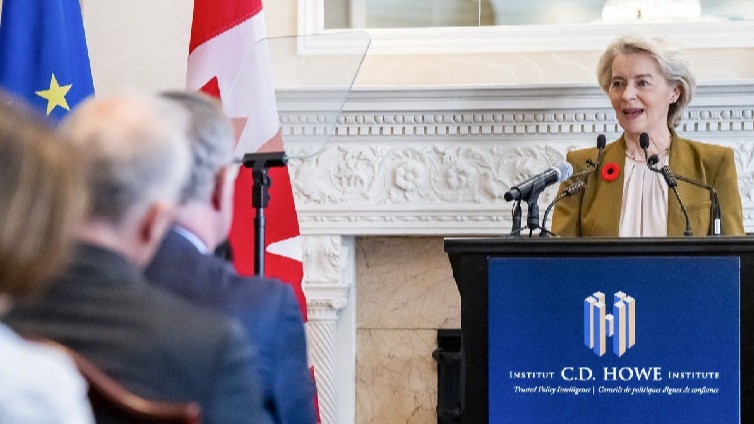
President of the European Commission Ursula von der Leyen delivers remarks ahead of the EU-Canada summit in Montreal on Thursday, Oct. 29, 2026. (Image Credit: THE CANADIAN PRESS/Christopher Katsarov)
Global partnerships

Canada should be ‘associate member’ of the European Union, von der Leyen says

Oct 29, 2026 | 12:39 PM

European Commission President Ursula von der Leyen said Thursday this week’s Canada-EU Summit opens up discussions on making Canada the bloc’s first “associate member.”

Ahead of meetings hosted Thursday and Friday in Montreal by Prime Minister Mark Carney, von der Leyen said in a speech that the term is helpful for deepening policy alignment.

“Canada cannot become a fully fledged member of the European Union because of geography. But we both want to bring our relationship to the highest level possible, and this is why we are discussing the idea of Canada becoming the first associate member of the European Union,” she said Thursday morning in Montreal.

After von der Leyen proposed associate member status in a September speech, Canadian and European officials immediately downplayed the language and instead spoke of an “alliance for the future.”

Several EU member nations, including Germany, rejected the term this week when proposed language was floated in documents ahead of the summit. Several European news agencies reported this week that the idea was off the table.

Prime Minister Carney has said the substance of the agreement is more important than the language used to describe the evolving relationship.

Von der Leyen’s visit comes after months of Carney pursuing closer ties with the EU. He has argued Europe complements Canada’s economic strengths and shares its values.

Thursday’s agenda includes a welcome dinner with elected and business leaders before Canadian and European leaders get down to talks on Friday.

In her Thursday speech, von der Leyen said the EU wants to work first with Canada and then with other nations to reinforce their national sovereignty and interests.

“We can no longer let ourselves be shackled by the limits of the old world order,” she said.

“We are witnessing a deeper decay in international order. Alliances and assumptions that have enabled our prosperity and security are changing rapidly.”

She cited “choke points” in trade, where one country coerces another by manipulating supply chains. She did not name specific countries, though her comments come in the context of U.S. tariffs and Chinese leverage over critical minerals.

She said countries can work strategically with close partners or try to face down threats on their own.

“We are seeing in real time our sovereignty being attacked,” she said.

Von der Leyen said a new partnership could see Canada use its mining expertise to do more to exploit mineral resources at home, such as those required for electric vehicles. Those efforts would be boosted by European “industrial demand, technology and investment.”

She said Canadian startups and researchers will soon be able to train their models on the EU’s supercomputers.

“Tomorrow we will finalize our agreement to bring Canada into Europe’s infrastructure for supercomputing,” she said Thursday.

Both sides are also working on joint projects in the Arctic on ocean monitoring, “critical raw materials” and connectivity as Russia rebuilds its Arctic military footprint.

The EU “will deepen Canada’s engagement” in university student exchanges through the Erasmus+ program, von der Leyen said. Both sides are also “working to strengthen Canada’s participation” in the next phase of a scientific research program called Horizon, she added.

She said there also could be cross-Atlantic collaboration between elected officials and judiciaries. The European Parliament recently announced it is opening a satellite office in Ottawa to facilitate more exchanges with Canadian MPs and senators.

“The co-operation could also entail parliament to parliament — between our two parliaments — and court to court,” she said.

Quebec Premier Paul St-Pierre Plamondon is not participating in the summit and instead sent his newly appointed chief diplomat Pascal Paradis.

St-Pierre Plamondon made the announcement Wednesday after Carney refused his request to speak at the summit.