Click here to sign up for our free daily newsletter.
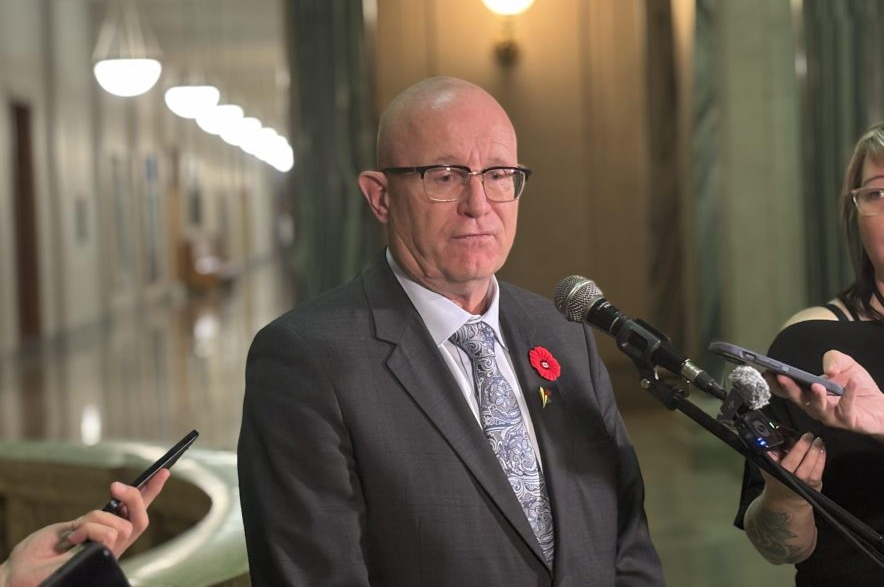
Saskatchewan Trade and Export Development Minister Warren Kaeding speaks to reporters about Canada’s trade relationships with the United States and China, including renewed Keystone XL discussions and the future of Chinese tariffs on Canadian canola products. (Image Credit: Jacob Bamhour/CJME)
improved relationship

Saskatchewan seeks trade progress with U.S and China

Nov 3, 2026 | 9:31 AM

The Government of Saskatchewan is hoping that renewed trade talks with the United States and China will open new opportunities for the province’s oil and agriculture industries, with discussions around the Keystone XL pipeline gaining momentum and a deadline approaching for temporary Chinese tariff relief.

Warren Kaeding, Saskatchewan’s trade and export development minister, said the province is encouraged by developments on both fronts, particularly as federal officials travel to China this week in an effort to strengthen economic ties.

The comments from Kaeding come after Prime Minister Mark Carney and U.S. President Donald Trump signalled progress toward a potential trade agreement over the weekend. Trump told reporters on Sunday that the two countries have developed a framework for a possible agreement, and suggested that reviving the Keystone XL pipeline could be part of the negotiations.

Kaeding welcomed the renewed attention to the project, saying additional pipeline capacity would provide new opportunities for Saskatchewan’s oil industry.


“I think any pipeline is important to our oil sector here in the province,” Kaeding said.

“Certainly, Keystone has been something that we’ve focused on pretty well from its time of origin. So we’re very excited that it’s back being discussed on literally both sides of the border.”

The Keystone XL project was cancelled in 2021 after then-U.S. president Joe Biden revoked a key permit. Although Trump has raised the possibility of bringing it back, no finalized agreement to restart the project has been announced.

Kaeding said additional routes to market could help Saskatchewan producers increase production and reach provincial growth targets.

“Any time we’ve got an additional outlet to move oil out of Saskatchewan is certainly going to enhance our industry,” he said.

“It’s going to allow us to get to the production goals that we’ve set for our producers here, and really gives that sector an opportunity to increase and expand.”

While the pipeline discussions have generated optimism in Saskatchewan, Canada and the United States are still working through trade disputes involving tariffs and market access. On Sunday, Carney said negotiating teams would continue working toward an agreement over the coming weeks.

With Americans heading to the polls on Tuesday for the midterm elections, Kaeding said Saskatchewan’s trade priorities will remain unchanged regardless of the political outcome.

“I don’t think it really makes a difference to what party’s in power,” he said.

“We certainly have a lot of things that we want to have accomplished here in Canada. We talk about our very integrated marketplace that we’ve got here, whether it’s oil and gas, it’s potash, it’s agriculture, food products.”

Kaeding said the province will continue advocating for fewer trade barriers and stronger access to American markets.

“It’s going to be the same message regardless of who’s on the other side of the border,” the trade minister said.

Meanwhile, Saskatchewan is also looking east as Canada works to rebuild its trading relationship with China.

Heath MacDonald, Canada’s agriculture and agri-food minister, is in China this week, while Maninder Sidhu, the federal minister of international trade, is scheduled to visit Beijing and Shanghai this week.

The ministers are expected to meet Chinese government officials and business representatives to discuss agricultural exports, investment opportunities and ongoing market-access challenges.

The visit comes as temporary Chinese tariff relief on Canadian canola meal and peas is scheduled to expire at the end of December.

Under an agreement reached earlier this year, China suspended additional tariffs on those products until Dec. 31. China also reduced tariffs on Canadian canola seed from nearly 85 per cent to a combined rate of 14.9 per cent under a separate arrangement.

Kaeding said maintaining access to the Chinese market is particularly important for Saskatchewan producers. He recently visited China and said businesses there were encouraged by the reductions.

“As we were there talking to industry, they were talking about how supportive they were that the tariffs were reduced and that ultimately it was going to affect the operations of their business,” he said.

“They were so looking forward to having this continue well into the future.”

Kaeding said he believes both countries support maintaining the improved trading relationship.

The minister said he also raised the issue directly with Sidhu during a trip to India a few weeks ago.

“He knows how important it is to extend that agreement or even eliminate tariffs,” Kaeding said.

The provincial trade minister said it is now up to Ottawa to ensure Saskatchewan’s canola concerns are addressed during discussions with Chinese officials.

“I’m a glass-half-full guy, and I’m very hopeful that we’re going to continue to see that extended,” Kaeding said.

Canada is also participating in the China International Import Expo in Shanghai, where it has been named the guest country of honour. The event runs from Thursday to Nov. 10.

According to Agriculture and Agri-Food Canada, Canadian exports of agriculture, agri-food, fish and seafood products to China were valued at $6.7 billion in 2025.

For Saskatchewan, Kaeding said the ultimate objective remains straightforward: reducing trade barriers and expanding opportunities for businesses to sell their products internationally.

“We’ve always been on record that we’d love it to be a tariff-free, open trade deal,” he said.

“We want what’s best for our producers, our manufacturers here, and we just want to be able to sell more product into the U.S.”

—