Click here to sign up for our free daily newsletter.
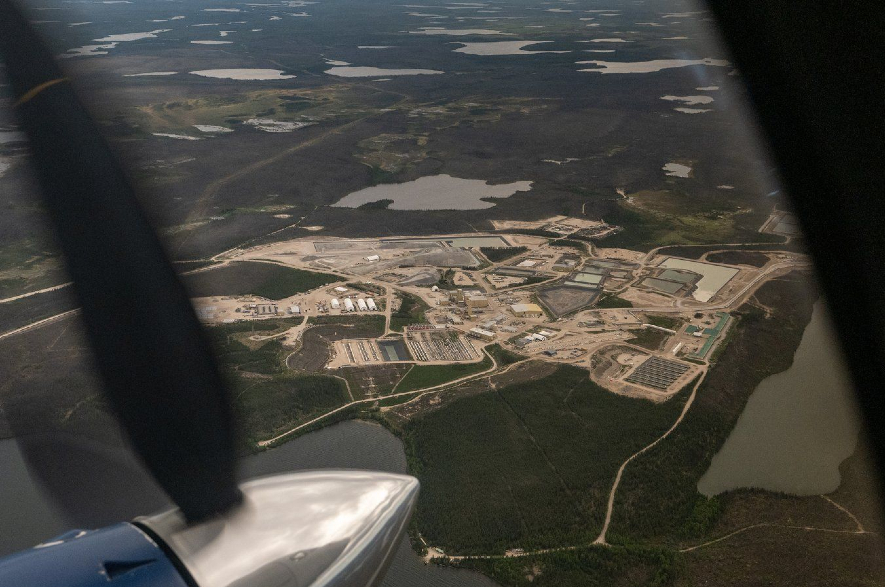
Cameco's Cigar Lake uranium mine site seen from an airplane following a media tour in Cigar Lake, Sask., Monday, June 15, 2026. (Image Credit: THE CANADIAN PRESS/Liam Richards)
NUCLEAR POWER

How competing nuclear designs could shape Saskatchewan’s energy future

Sep 30, 2026 | 5:00 PM

Saskatchewan announced on Tuesday it is looking at building two large nuclear reactors in the province’s northwest.

Premier Scott Moe said nuclear power will play a part in the province’s broader electrical grid by supplying at least 2,600 megawatts by 2050 and thus ensuring the energy needs of the province are met in the future.

The province has several options for nuclear reactors, including those made by Westinghouse and those made by AtkinsRéalis (formerly known as SNC-Lavalin), which use CANDU (Canada Deuterium Uranium) reactor technology.

Tim Gitzel, CEO of uranium company Cameco which is headquartered in Saskatoon, said he expects the company to play a substantial role in the province’s nuclear plan. He said Cameco owns 49 per cent of Westinghouse, which makes AP1000 reactors.

Gitzel said Saskatchewan uranium would be refined at Blind River and converted at Port Hope, Ontario, keeping those stages in Canada. Enrichment is not currently available in Canada.

He said Cameco could consider building Canadian enrichment capacity in future if Ontario and Canada develop a fleet of AP1000 reactors.

“We’ve positioned our company to be ready for this day. We’ve got the fuel ready. We’ve got a reactor ready to build. It’s being built in 14 different places right now. There’s six operating, and so we’re ready to go,” Gitzel said.

He said the price of any reactor would be site specific.

“There are other jurisdictions building now, and so it’s like when you put IKEA furniture together. The first one takes you about a month and you get better at it over time.”

READ MORE: What Saskatchewan can learn from an Ontario nuclear host community

Gitzel said that build time for a AP1000 reactor would be about 10 years.

“We have a product that’s ready. It doesn’t have to be designed. It’s fuel ready. It’s design ready. It’s been licensed in the U.S. and the Canadian government is looking at it. So we’re we’re we’ll be the first off the mark if they pick our reactor,” he said.

Carl Marcotte, senior vice-president marketing and business development at Candu Energy Inc., said CANDU reactors use natural uranium mined in Saskatchewan, and enrichment is not required.

Marcotte said possible reactor ownership and operating models include provincial and private-sector ownership, a power purchase agreement, or full SaskPower ownership.

He said Tuesday’s announcement was “a really big deal.”

“The province, I think, is doing things in just the right sequence. It’s 80 to 90 year assets you’re building, so you’ve got to get it right, and it has to be flexible. It has to build on Saskatchewan’s strengths, and I think that’s what the province is doing.”

Marcotte also said it was hard to put a price on what reactors might cost.

“So much of it is about local conditions. There are all kinds of industry price points: $5 million per per megawatt, or $24 million, and everything in between. That translates into $7 or $8 billion for a small plant, $15 billion for a really big plant. So those are the big, rough, round range of numbers.”

He said the work to do the cost estimate would take a couple of years, Indigenous consultation and project definition may take two to four years, with total planning estimated at four to six years. Construction is expected to take about five to six years.

He said CANDU was something that a Diefenbaker government mandated in the late 1950s when scientists first started working on how to use nuclear technology for peaceful civil purposes, and they were told to make sure you can build a reactor with components made in Canada and it runs on natural uranium.

“The uranium goes for a first level of processing in northern Ontario, and then final fuel manufacturing outside of Toronto or Port Hope. We don’t do a whole lot to that uranium other than clean it up and package it, and then it goes right into the reactor.

“It’s the only reactor design in the world like that. It’s cheaper than enriched fuel reactors, much simpler, and it doesn’t have to leave our borders. Basically we like to joke that CANDUs kind of burn dirt.”

—