Click here to sign up for our free daily newsletter.
(Image Credit: File photo/battlefordsNOW)
Solideum

Unity becomes testing ground for new heavy oil technology

May 15, 2026 | 6:01 AM

In a town better known for grain elevators and railways than energy innovation, a new heavy oil pilot project is giving Unity a chance to become an early testing ground for technology its developers believe could reshape how bitumen is processed in Western Canada.

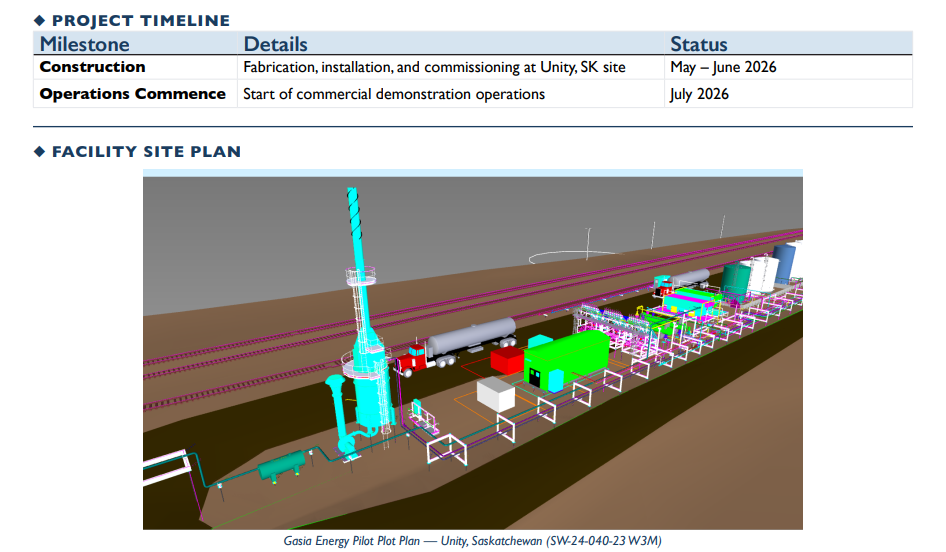
Gasia Energy has begun construction on a one-year pilot heavy oil separation facility northwest of Unity using technology developed at the University of Calgary. The facility is expected to process up to 3,000 barrels per day of heavy crude into products including asphalt.

“Construction actually started this last week,” Gasia Energy president Ed Koshka said. “So we started doing some civil work on the site.”

The project is being built on CP Rail land at the Simba Transload site northwest of town.

Koshka said the company began searching for a pilot location after regulatory hurdles prevented it from testing the technology at an Alberta industrial site already operated by the company.

Saskatchewan quickly emerged as the preferred option because of its rail infrastructure, abundant heavy crude supply and provincial incentives supporting new energy technology projects through the Saskatchewan Petroleum Innovation Incentive program.

Unity Mayor Bob Abel said council viewed the proposal as an opportunity for economic growth in a rural community where large industrial investment does not happen often.

“Any time somebody shows an interest in your community, it is a bit exciting,” Abel said.

According to Abel, the three-month construction phase is expected to bring between 50 and 75 jobs and generate more than $3 million in economic activity through local hotels, restaurants, gas stations and campgrounds.

Koshka said the company plans to hire local operators from communities including Unity, Wilkie and Kindersley once the facility is operational.

“Solideum”

At the centre of the project is a separation technology known as Solideum, developed by University of Calgary researcher Dr. Ian Gates. Instead of fully refining heavy crude, the process separates bitumen into different usable components.

“There’s no upgrading involved. It is merely just a separation process,” Koshka said.

He said traditional heavy crude processing often relies on vacuum distillation systems that require large amounts of energy and steam generated from water. The new process aims to achieve similar separation results at lower cost and lower energy use while eliminating the need for water in the process.

“So we don’t need any water to make the steam,” Koshka said. “And so that’s a huge advantage to anyone that wants to make asphalt out of bitumen.”


(Image Credit: submitted/Ed Koshka)

Koshka said the broader goal is to create more value from Western Canadian bitumen closer to where it is produced instead of shipping raw feedstock to major refining hubs in the United States.

He noted heavy bitumen is often sold at a discount of roughly $15 to $20 per barrel compared to light crude oil prices, and said processing more of that product domestically could allow more of that economic value to remain in Western Canada.

“Why not capture that value in Western Canada?” he said.

The company expects mechanical construction to be completed by late July, with commissioning and startup activities planned for August. The one-year pilot phase would follow.

Abel said the testing phase will allow emissions and odours to be monitored before any long-term expansion is considered.

“We’re not going to let them stink the town out, so to say,” the mayor said.

Koshka said the company plans to use vent gas capture systems and other mitigation measures to reduce emissions and odours from the site.

Public feedback

While about two nearby residents have raised concerns about smell and possible property impacts, Abel said council believes the site is appropriate because it is already zoned industrial and located on railway land.

“They just need to understand that their council is looking out for them and we’re not going to let something that’s a danger to the community exist,” he said.

Koshka acknowledged the company moved quickly during the permitting and engineering stages and likely should have done more early communication with residents.

“We probably haven’t done as much community outreach as we should have, but we certainly are doing that now,” he said.

If successful, both the company and mayor say the pilot could lead to larger-scale expansion in the future.

“There is the opportunity that if things are doing really well, of expansion and extending operation potential of 25 plus years after that,” Abel said.

Koshka described the Unity project as “a bit of a launch point for the technology” as the company explores broader applications across Saskatchewan and Alberta.

Kenneth.Cheung@pattisonmedia.com