Click here to sign up for our free daily newsletter.
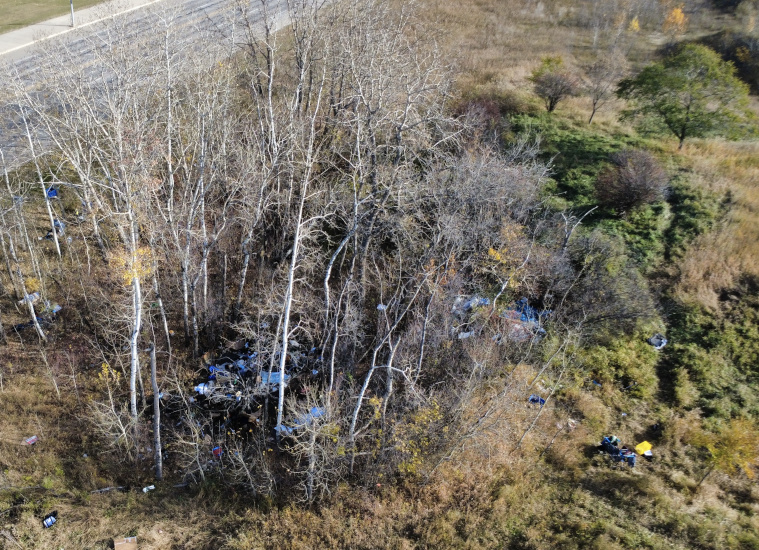
A homeless encampment visible off of 15th Street East, across from Sask Polytech campus. (Image Credit: Nigel Maxwell/paNOW)
Counting homelessness

Prince Albert homeless count expected to rise as teams expand encampment coverage

Oct 21, 2026 | 3:00 PM

Prince Albert’s latest count of people experiencing homelessness is expected to surpass last year’s total of 279, with additional shelter beds and expanded efforts to reach people living in encampments contributing to the anticipated increase.

Riverbank Development is co-ordinating the point-in-time count, which brings together information from shelters, outreach teams and volunteers to estimate how many people are experiencing homelessness over a 24-hour period.

Teegan Jeffers, Riverbank’s project officer and coordinated access lead, said this year’s effort includes dedicated teams visiting encampments that have not necessarily been captured in previous counts.

“We have some dedicated and trained teams that already have relationships with a lot of people that are living there,” she said.

“So they’re the best ones to go into the bush, into those entrenched sites, and try to get some data for people that will help us out.”

Additional beds at the YWCA’s Gateway House and the inclusion of a domestic violence shelter operated by Peter Ballantyne Cree Nation will also contribute to the shelter portion of the count, she said.

The information will help guide funding decisions and identify gaps in services, including supportive housing and shelter spaces.

“We’re getting an increase in shelter beds, but I mean, still barely scratching the surface,” she said.

The count involves several approaches. Teams visited encampments during the day, while six teams of volunteers were scheduled to make evening rounds through areas where people may be sleeping outside, including doorways and alleys.

Shelters will provide their overnight bed counts, while detox, emergency and mental health inpatient services will provide anonymous information about people who are unhoused.

Jeffers said the results must be understood as an estimate rather than a complete picture of homelessness in Prince Albert.

“It’s not a firm number. It’s an estimate from a 24-hour period.”

Prince Albert also collects ongoing information through its coordinated access system, which draws on frontline workers’ efforts to connect people with housing.

For the point-in-time count, organizers use anonymous identifiers and compare observations to reduce the risk of counting someone twice.

Jim Woodcock, the city’s community safety and well-being co-ordinator, joined crews visiting encampments Wednesday morning. He said people responded well when the teams explained the purpose of the count.

“It’s just data that’s going to be used in aggregate to apply for funding,” he said. “And people understand that.”

He said using experienced outreach workers and bylaw officers for the encampment visits helped address the apprehension volunteers might feel about entering secluded or wooded areas after dark.

The work also connects with the city’s broader response to encampments, which includes efforts to link people with housing and treatment.

Removing an encampment does not resolve the circumstances of the people living there, he said.

“We can take down an encampment, but those people still are going to go somewhere.”

Jeffers said volunteers received training on approaching people respectfully, with the aim of making the count a positive experience for both participants and those gathering the information.

“We’re not out there to traumatize anybody tonight. We’re not out there to agitate anybody,” she said.

“We’re out there to be friendly faces to a group of people that are often very stigmatized in our community.”

Results are expected in mid- to late November, with a public report to be posted on Riverbank’s website.

—

panews@pattisonmedia.com