Click here to sign up for our free daily newsletter.
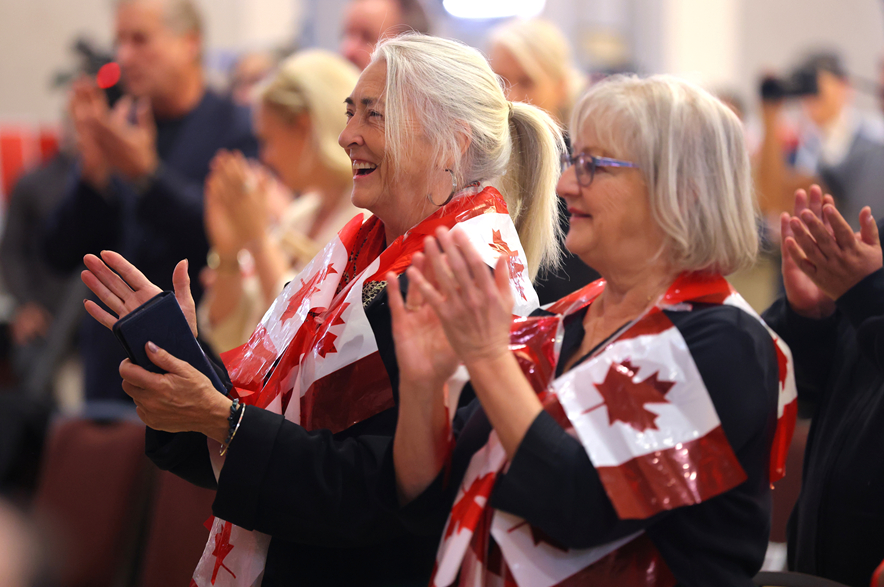
Supporters wait for results at the pro Canada watch party in Edmonton, Monday, Oct. 19, 2026. (Image Credit: THE CANADIAN PRESS/James Maclennan)
Separation conversation

Alberta separation debate likely to quiet down, but won’t disappear, Sask. professors say

Oct 20, 2026 | 1:52 PM

Two university professors in Saskatchewan say the conversation around Alberta separation isn’t a dead issue, but it’s a conversation that will likely quiet down for a while.

While the votes in Alberta’s referendum were still being counted on Tuesday morning, around 75 per cent voted to have Alberta stay in Canada instead of moving ahead to a binding referendum on separation. But Jason Childs, an economics professor at the University of Regina, said there are still hundreds of thousands of people who voted in favour of separation.

“There’s some sort of appetite here. It’s not just a fringe minority of three people on the couch somewhere talking about it,” Childs said.

“Do you think the NDP, federally, is a fringe party? Maybe, but you know, voter percentage for separation in Alberta was greater than the federal NDP got in the last federal election. So what do you do with that?”


Childs said he believes the referendum will have a lasting impact, but said he doesn’t believe it will take on the same intensity as the Quebec’s previous referendums on separation.

“I think it’s going to be a very quiet undertone for the next little bit,” Childs said.

“When Quebec had the referendum in the ‘80s, they got just under 40 percent. This isn’t even close to that, so I think it’s going to persist as sort of this undertone that’s sort of bubbling under the surface.”

Childs said the question now is how the federal and provincial governments respond to the whole suite of questions included in the referendum.

“I think what has happened is Trump happened, and several other things happened, and we’ve got a shift in tone, at least from the federal government,” he said.

“We’ll see if that translates into action. If it does, I think this issue gets quiet for a while. If it doesn’t translate into meaningful action on some of these issues, I think this thing heats up again pretty quickly.”

Childs said he doesn’t think a separatist party will form government in Alberta anytime soon.

“There’s a real risk for Danielle Smith and the conservatives, because if they fission off into a separatist party and a more traditional federalist conservative party, they’ll split that vote on the right and we’ll have NDP governments in Alberta for the foreseeable future,” said Childs.

“If we get that schism, then Alberta is going to see some real changes and go in a very different direction than it has, and I don’t think there’s an appetite for that among voters, when you look at the other nine questions.”

Dwight Newman, a law professor at the University of Saskatchewan and Canada Research Chair in Rights of Communities and Constitutional Law, said the referendum results made it clear that separation is not the path Alberta is pursuing now.

“I think there are lasting impacts from having had that kind of debate in Alberta. Just the discussion at a larger level than ever in the past,” said Newman.

“It’s something that friends and neighbors and families have argued over, so I think there will be some lasting impacts from that, just in terms of that debate being present in the society.”

Newman emphasized that 25 per cent of voters wanting to take the next step to separate is quite significant.

“That said, some of those that voted option two might have been doing that just to try to gain leverage in discussions with Ottawa, or to send a message of some kind, and I think there’s sort of other polling that suggests that some people were doing that,” he explained.

“But the very fact that many were ready to vote for something that would take those next steps certainly speaks to a lot of frustration by at least a meaningful part of the Alberta population about the way things have been going.”

Newman agrees with Childs that the conversation around Alberta separation will likely quiet down in the wake of the vote.

“That’s one of the things that was probably an aim with having the referendum is to settle that for at least a while,” he said.

“But with a quarter of the population having voted that way, it’s difficult to say that it’s a totally dead issue, so it could come back someday, but having had a vote right now that’s 75 to 25, roughly, it’s not something that would make sense to be having another referendum anytime soon, and so this should settle it for a while.”

Pointing to some of the other questions on the referendum, Newman said the results show that there is still a lot of frustration with Ottawa in Alberta.

“What’s interesting on the constitutional change questions is, it looks like there’s one that’s not succeeding, and the others aren’t by as high a margin as one might have thought if there was quite as much frustration as some had thought,” Newman said.

“But there are a number of the (referendum questions) that look like they’re succeeding and positioning Alberta to engage in discussions about possible constitutional changes, and that could be positive as a way of addressing some of those grievances.”

Newman said Smith will have to make some difficult decisions about how the province moves forward based on the results of the referendum.

—