Click here to sign up for our free daily newsletter.
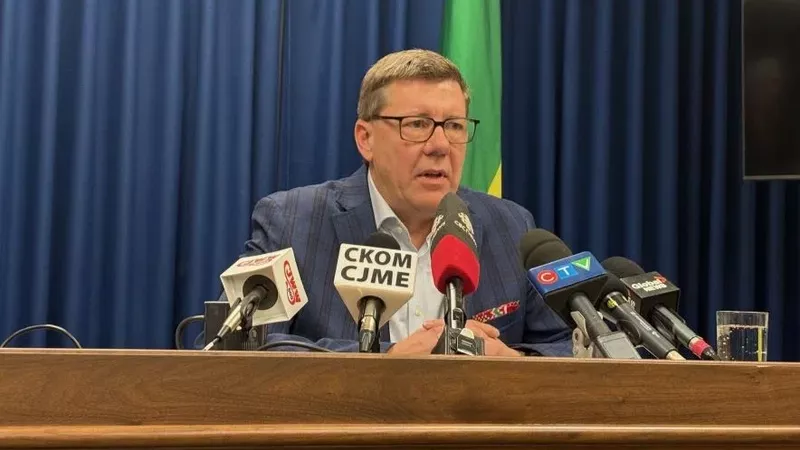
Scott Moe says the focus should be on de-escalation as a trade war with the United States looms. (Mia Holowaychuk/650 CKOM)

Moe calls for ‘de-escalation,’ but supports first round of counter-tariffs

Feb 3, 2025 | 12:03 PM

Saskatchewan Premier Scott Moe says Saskatchewan is continuing to call for “de-escalation” of the looming trade war between Canada and the United States, but says he supports the first round of counter-tariffs from Ottawa.

Moe made the comments during a public address on Monday Feb. 3, following U.S. President Donald Trump’s weekend announcement of 25 per cent tariffs on Canadian goods and a tariff of 10 per cent on Canadian energy.

Canada is expected to respond with its own tariffs on Tuesday, as the American tariffs take effect.

“We, unfortunately, do support the first suite of counter-tariffs that have been introduced,” Moe said.

But while he said the Government of Saskatchewan is backing the first round of counter-tariffs, Moe emphasized he would like to see Ottawa – and all Canadian leaders – working towards removing all tariffs rather than escalating the trade dispute.

“We need to do everything that we can to engage and to de-escalate the talk of tariffs,” the premier said.

“Everything we do as leaders – political leaders, business leaders, community leaders – needs to be focused on the long term.”

Moe called the American tariffs “very, very harmful,” and said the looming trade war will harm everyone in both nations through rising prices and job losses.

The premier pointed specifically to the agricultural, energy, retail and mining sectors as the areas expected to suffer during the trade dispute. Moe called on political and business leaders to reach out to their American contacts in order to help make the case against the tariffs.

But, Moe added, while the United States is Saskatchewan’s largest trading partner, his government has worked hard in recent years to diversify its trade interests and bring on new partners, meaning the province might not be hit as hard by the U.S. tariffs as other parts of Canada.

The premier has previously moved to strengthen security at the Saskatchewan-United States border in response to criticisms of Canada’s border security from Trump and on Feb. 3, he emphasized that similar efforts have been happening across Canada.

Moe said he would like to see the Canada Border Services Agency folded into the Canadian military, which would allow for troop deployments along the border to help stem the flow of illegal migration and drug trafficking, and would also bring Canada closer to meeting its NATO-mandated defence spending commitments, which has long been a point of contention for Trump.

The premier said he has brought the idea forward with other premiers and with Dominic LeBlanc, Canada’s minister of intergovernmental affairs.

Moe joined the Evan Bray Show earlier on Monday morning for an exclusive interview to share his thoughts on the tariffs and the looming trade war:

Business analyst Paul Martin said price increases will start to be felt “fairly shortly” in Canada because of how integrated the North American economy is. He said grocery items, particularly fruits and vegetables, will soon be going up in price.

Martin added that relations between Canada and the U.S. will be damaged by the trade dispute. The fallout could even affect the relationships between different regions of Canada if one part of the country believes it is suffering the consequences of the tariffs more than others.

Jason Childs, a professor of economics at the University of Regina, said any tariffs will cause economic hardship.

“Any time you get a restriction in trade, you generally make both parties poor,” he said. “Restricting trade tends to harm people and that’s that’s something I think we should avoid.”

Childs said the Canadian dollar is likely to take a significant hit as a result of the American tariffs and a drawn-out trade war could take a big bite out of Canada’s economy, especially in Saskatchewan and Alberta.

–with files from The Canadian Press and 650 CKOM’s Lara Fominoff