Click here to sign up for our free daily newsletter.
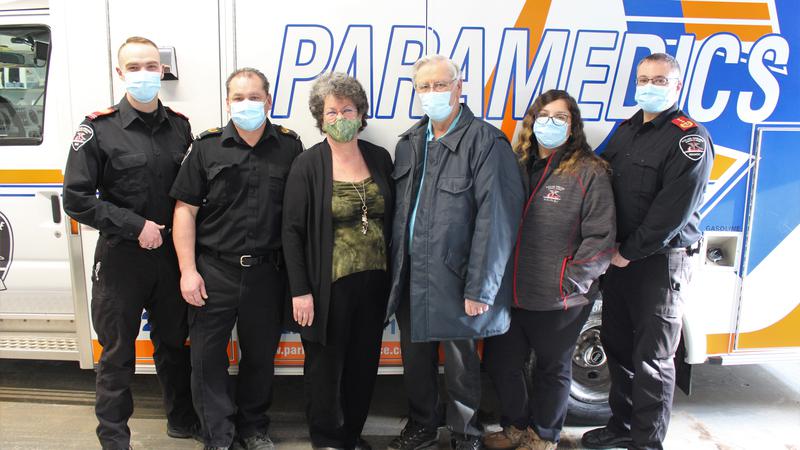
From left to right: Matt Leblanc, Darren Russell, Colleen Quiring, Cliff Quiring, Sherrilynn Halkett, and Ramsay Bellisle. (Ian Gustafson/paNOW Staff)
Road to Recovery

‘Without them guys there’s no way that I would survive’: P.A. man thanks first responders after surviving cardiac arrest

Jan 23, 2021 | 8:00 AM

Prince Albert’s Cliff Quiring is alive to tell the tale and thank the first responders who saved his life.

Late in the afternoon one day last month the 61-year-old wasn’t feeling very well when he got a sudden pain in his arm. His wife Colleen asked him if he wanted to go to the hospital. He declined. She explained that’s when his eyes began to roll back into his head and he fell back on the bed. He’d had a heart attack.

Although she didn’t know what was happening at first, that’s when she took early action and called 911. Parkland Ambulance showed up four minutes later. While waiting for the paramedics, the dispatcher kept Colleen calm and walked her through how to do Cardiopulmonary Resuscitation (CPR).

“I had taken a CPR course, so I knew what to do and she walked me through the start of it and I just did, I didn’t even think, I just did what I needed to do,” Colleen said.

Cliff was unresponsive when paramedics arrived and after working on him they took him to the Victoria Hospital but he was later transported to Royal University Hospital in Saskatoon.

“When I lost consciousness in the bedroom, I remember little vague bits and pieces for the rest of the day but then after they put the stints in and I was coming around again Colleen was around and she told me I was in Saskatoon,” he said. “I had no idea of everything that transpired from the time I lost consciousness to waking up.”

Cliff was in a coma for three days but was eventually released from hospital on Dec. 27, six days after the incident.

Cliff added his recovery has been going well and Colleen said doctors have called him a Christmas miracle.

“When I was at the hospital the doctor came in to talk to me and he said very few people survive the type of heart attack I had,” Cliff said. “He said the numbers are really low on that and the ones that do they generally have a brain injury after that.”

Friday afternoon Cliff and Colleen gathered with the four staff members at Parkland Ambulance who were responsible for saving his life.

“Without them guys there’s no way that I would survive, absolutely zero chance,” Cliff said.

First responder reaction

Sherrilynn Halkett, the emergency medical dispatcher who was on the phone with Colleen Dec.21, said those types of situations never get easy but added there is always so much adrenaline when the call first comes in.

“She was a really good caller, so we got CPR started quickly,” Halkett said.

“Even if someone knows CPR sometimes when they’re in that situation they forget what to do so it’s really good that we can provide that to them.”

Friday’s get-together was the first time she was meeting one of the people she’d helped save and admitted it was overwhelming.

“…we take a lot of bad calls and it’s really nice to have one like this. A lot of the time we don’t hear what happens after the call, it’s really nice they reached out and wanted to meet us,” she said.

Paramedics Matt Leblanc and Darren Russell with Parkland Ambulance were the two who first responded to the call, followed by Ramsay Bellisle.

Leblanc explained Colleen did the right thing and took Cliff off the bed and onto the floor so she could achieve more effective compressions. He and his colleague had to resuscitate Cliff a few times including in the house and again on the way to the hospital.

“From what we did it all stems back to his wife being able to do what she did – the compressions at the beginning,” Russell said. “And that’s the most important thing right there is that gives us the chance and the opportunity to continue our job for the outcome that was.

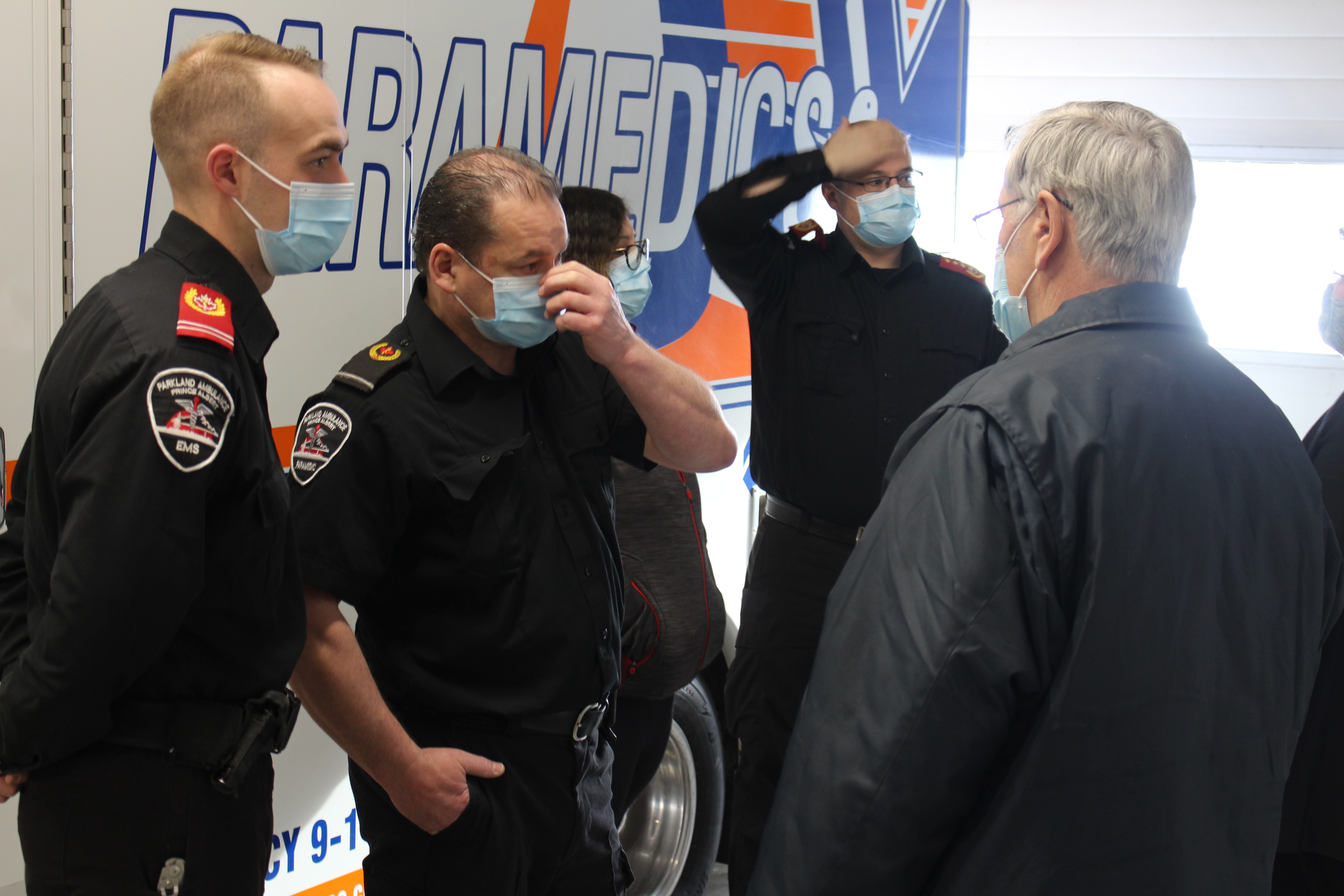
Matt Leblanc and Darren Russell speak with Cliff Quiring as he thanks them for saving his life. (Ian Gustafson/paNOW staff)

“The brain death starts after five minutes of not getting any oxygen,” Leblanc said. “And so, with [Colleen’s] early recognition, early CPR, and then calling 911 early, improved his chances greatly and the situation would be different if she didn’t do compressions. I know he was coming here to say thank you to us but really he should be thanking his wife.”

Leblanc added meeting patients who have survived cardiac arrests doesn’t happen very often but when it does all the training and work they put it in makes it worth it.

Ian.gustafson@jpbg.ca

On Twitter: @iangustafson12