Click here to sign up for our free daily newsletter.
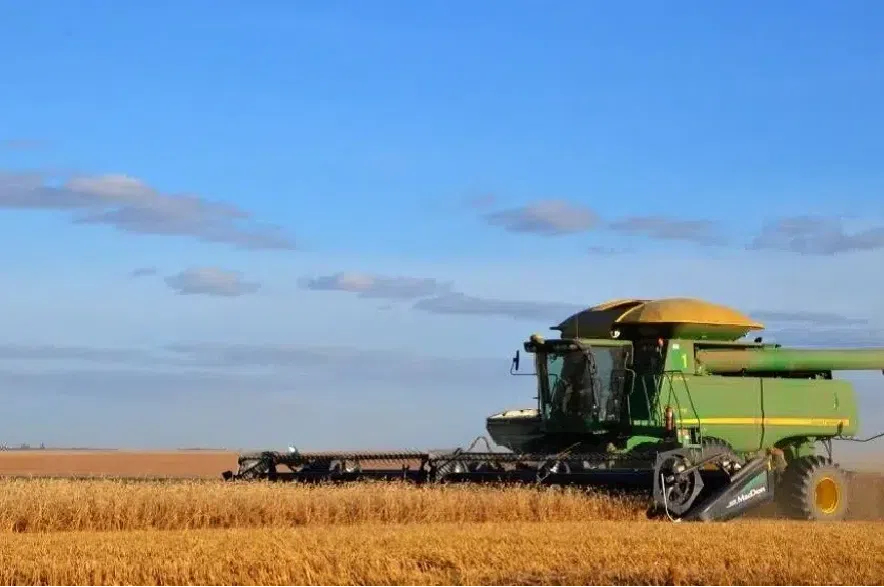
The 2026 harvest in Saskatchewan is nearly complete. Only a few acres of later-seeded crops have yet to be brought in. (Image Credit: File photo/CKOM)

Saskatchewan harvest 99 per cent complete, yields match 10-year average

Nov 5, 2026 | 3:09 PM

With harvest wrapping up across Saskatchewan, the province has issued its final crop report of 2026.

The Saskatchewan Ministry of Agriculture reported that the overall harvest is 99 per cent complete, with “only a few acres of later-seeded crops remaining in the field.”

Flax currently sits at 93 per cent complete, while 97 per cent of canary seed has been harvested.

While producers dealt with several challenges this growing season, including delayed seeding, flooding, harvest rain, frost and humidity, the ministry said crop yields this year were consistent with the 10-year average.


Many crops graded in the top two categories, but there was some downgrading due to pest activity and late-season rain. Among the pests having an impact were bertha armyworms, cabbage seedpod weevils and Richardson’s ground squirrels.

Eighty-one per cent of canola crops were graded as 1 Canada (CAN), compared to the 10-year average of 83 per cent. Sixteen per cent were 2 CAN, compared to the 13 per cent average over the past decade. Two per cent came in at 3 CAN, versus the average of three per cent. The one per cent that was graded as sample was consistent with the average.

The results for lentils were somewhat lower. The 10-year average for 1 CAN is 31 per cent, compared to 25 per cent this year. However, 58 per cent was graded at 2 CAN, versus the average of 52 per cent. The 3 CAN levels were about on par: 16 per cent this season, compared to the 15 per cent average. One per cent came back as sample grade, while the average rate is two per cent.

The rate of 1 CAN field peas also dipped slightly to 39 per cent, compared to the 42 per cent average. The rate of 2 CAN remained fairly consistent at 52 per cent in 2026, versus the 51 per cent average. Eight per cent was rated 3 CAN, compared to an average of six per cent. Sample-rated field peas remained consistent at one per cent.

Durum and barley both took big hits in terms of the highest-rated crops. Twenty-five per cent of durum graded as 1 Canada Western (CW), compared to the 10-year average of 39 per cent. Thirty per cent graded as 2 CW, versus the average of 28 per cent. The rate of 3 CW durum was 29 per cent, compared to the 10-year average of 20 per cent. Meanwhile, 16 per cent graded as “other,” while the average sits at 13 per cent.

The rate of malt-graded barley was cut nearly in half in 2026: 16 per cent, compared to the 10-year average of 31 per cent. Sixty per cent graded as 1 CW, compared to the average rate of 51 per cent. And 24 per cent received a 2 CW grade, versus the average rate of 18 per cent.

According to the report, the average silage yield in the province was 7.45 tons per acre, up from last year’s yield of 5.82 tonnes per acre. The lowest yields came from the central portion of the province, while the highest came from the southwest.

Hay crops mostly rated as either excellent or good, with “some small areas reporting poor hay quality.”

Looking ahead, the agriculture ministry said most regions have sufficient soil moisture heading into winter. Cropland topsoil moisture levels are either surplus or adequate in 88 per cent of areas, while the same can be said for 86 per cent of hayland topsoil.

Pasture topsoil comes up a little shorter. Seventy-nine per cent is either surplus or adequate, 19 per cent is short and two per cent is very short.

Overall pasture conditions in Saskatchewan are good entering winter. Ten per cent are rated excellent, 63 per cent are in good condition, 23 per cent are fair and one per cent are very poor.

The government reminded producers that the deadline to register post-harvest claims, submit product declarations and/or request an extension for insurance is coming up on Nov. 15. The deadline to pay Crop Insurance premiums without interest has been extended to Dec. 31.

—