Click here to sign up for our free daily newsletter.
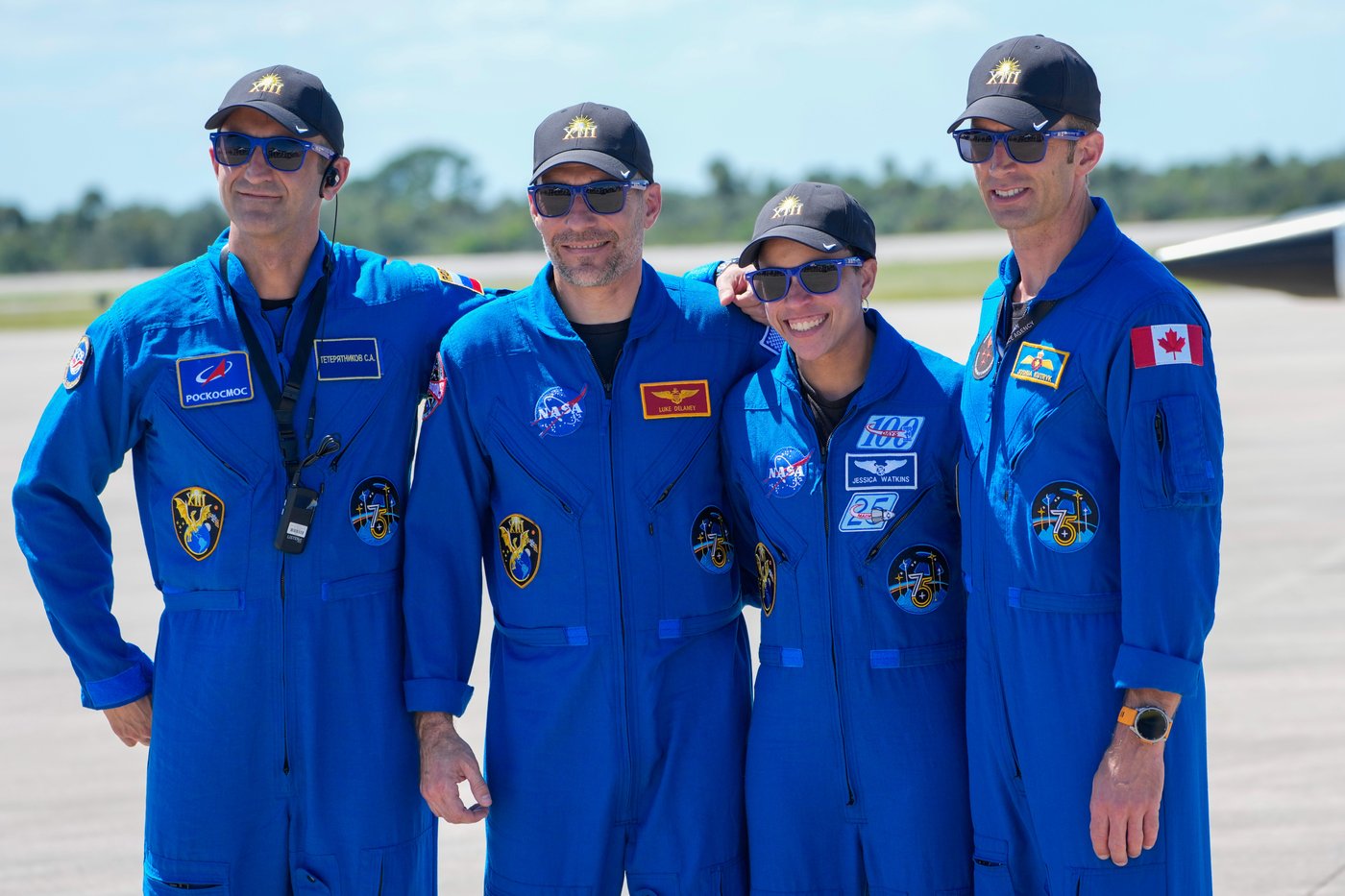
The crew for the upcoming NASA SpaceX launch (from left) — Sergey Teteryatnikov of Russia, pilot Luke Delaney, commander Jessica Watkins and Joshua Kutryk of Canada — pose for a photo at a news conference at the Kennedy Space Center in Cape Canaveral, Fla., on Saturday, Sept. 26, 2026. (AP Photo/John Raoux)

Canada’s memorable year in space set to continue with NASA’s SpaceX Crew 13 mission

Sep 30, 2026 | 11:20 AM

COCOA BEACH — Astronaut Joshua Kutryk is set to blast off for the International Space Station on Thursday as Canada continues a memorable year for space exploration and research.

The 44-year-old is one of four people assigned to NASA’s SpaceX Crew 13 mission, which is scheduled to take off from the Kennedy Space Center for a six-month mission.

After arriving at the space centre in Florida on Saturday, Kutryk said he’s grateful to be part of an international team that includes NASA’s Jessica Watkins and Luke Delaney, and Roscosmos cosmonaut Sergey Teteryatnikov.

“I’m also excited to do it as a Canadian,” Kutryk told reporters.

It has been an exciting year for Canadian space exploration, said Mathieu Caron, director of astronauts, life sciences and space medicine at the Canadian Space Agency.

Canadian Jeremy Hansen was one of four astronauts aboard the Artemis II mission in April — humanity’s first trip to the moon in more than 50 years. The 10-day lunar fly-around saw Hansen and his crewmates travel farther from the surface of the Earth than anyone before them.

The Artemis mission thrilled people around the world and many on social media praised the astronauts for bringing joy and hope for the future at a time of geopolitical turmoil.

Caron said space missions show the value of international co-operation. The space station has had crews from around the world since 2000.

“Ever since that point, we’ve always been in a position where the focus of the partnership, of all international partners, was a successful operation and the safe operation of the of the space station,” he said.

“And you can imagine over 27 years a lot of things have happened and that has never wavered.”

Canada’s robotics systems — the well-known Canadarm and its followup Dextre — have been critical to the construction and maintenance of the International Space Station.

Kutryk’s mission will be quite different from Hansen’s Artemis mission. The moon trip was more like a sprint, with a longer distance but a much shorter duration, Caron said.

He said the mission astronauts will take care of the space station facility, take part in a large number of experiments and really “get to experience space on a much deeper level because they have to live and work there for many months and find ways to do that effectively.”

“Life in space is never boring, so just following what Josh is doing to help (operate) this beautiful world-class laboratory is going to be fascinating,” he said. “But we’re also excited about all the science he’ll be doing on the space station.”

Former astronaut Bob Thirsk was the first Canadian astronaut to go on a long-duration expedition to the space station. Thirsk recalled getting up to the station and being so focused on his tasks that another astronaut tapped him on the shoulder to remind him to look out the window.

“This chill went down my spine and I realized the privilege that I had,” he said. “That I fulfilled a childhood dream as well.”

Thirsk said he emailed Kutryk Tuesday to tell him while he has a lot of work to in space, he should also try to enjoy every moment of the launch.

“There will be huge swings of G-forces on his on his body like a roller-coaster kind of ride, so that’ll be a lot of fun,” he said. “But savour every moment of that eight-and-a-half minute adventure.”

Thirsk said spending a long time in space changes astronauts personally and professionally.

He said that after spending months looking back at Earth and reflecting on civilization, he returned with a more global perspective on poverty, overpopulation, inequality and environmental damage.

“We see a different panorama of countries and topographies every 90 minutes but also a world without borders,” Thirsk said. “To realize that everything is one and everything is connected on the surface below.”

This report by The Canadian Press was first published Sept. 30, 2026.

Kelly Geraldine Malone, The Canadian Press