Click here to sign up for our free daily newsletter.
One elm tree will take up over 100 litres of water and treatment chemical in several hours. The city plans to treat 31 trees in Kinsmen Park this year. (Image Credit: Susan McNeil/paNOW)
No confirmed cases yet

Prince Albert moves to protect Kinsmen Park elms from Dutch elm disease 

Jul 21, 2026 | 4:35 PM

Prince Albert is taking a proactive approach to Dutch elm disease, even though the city said it remains free of confirmed cases. 

Crews with Regina-based Living Tree Environmental are spending about 10 days in Kinsmen Park injecting roughly 31 American elm trees with a fungicide meant to protect them for three years. 

Marco Hale with Living Tree Environmental said the treatment is meant to prevent the disease, not cure it. 

“The earlier and faster you remove the tree, the better,” he said. “There’s no cure for Dutch elm disease. The only thing you can do is find it quickly and cut the tree down to prevent the spread any further.” 

Hale said American elms are vulnerable to the disease, which can be spread by elm bark beetles, the movement of infected firewood and contaminated pruning tools. 

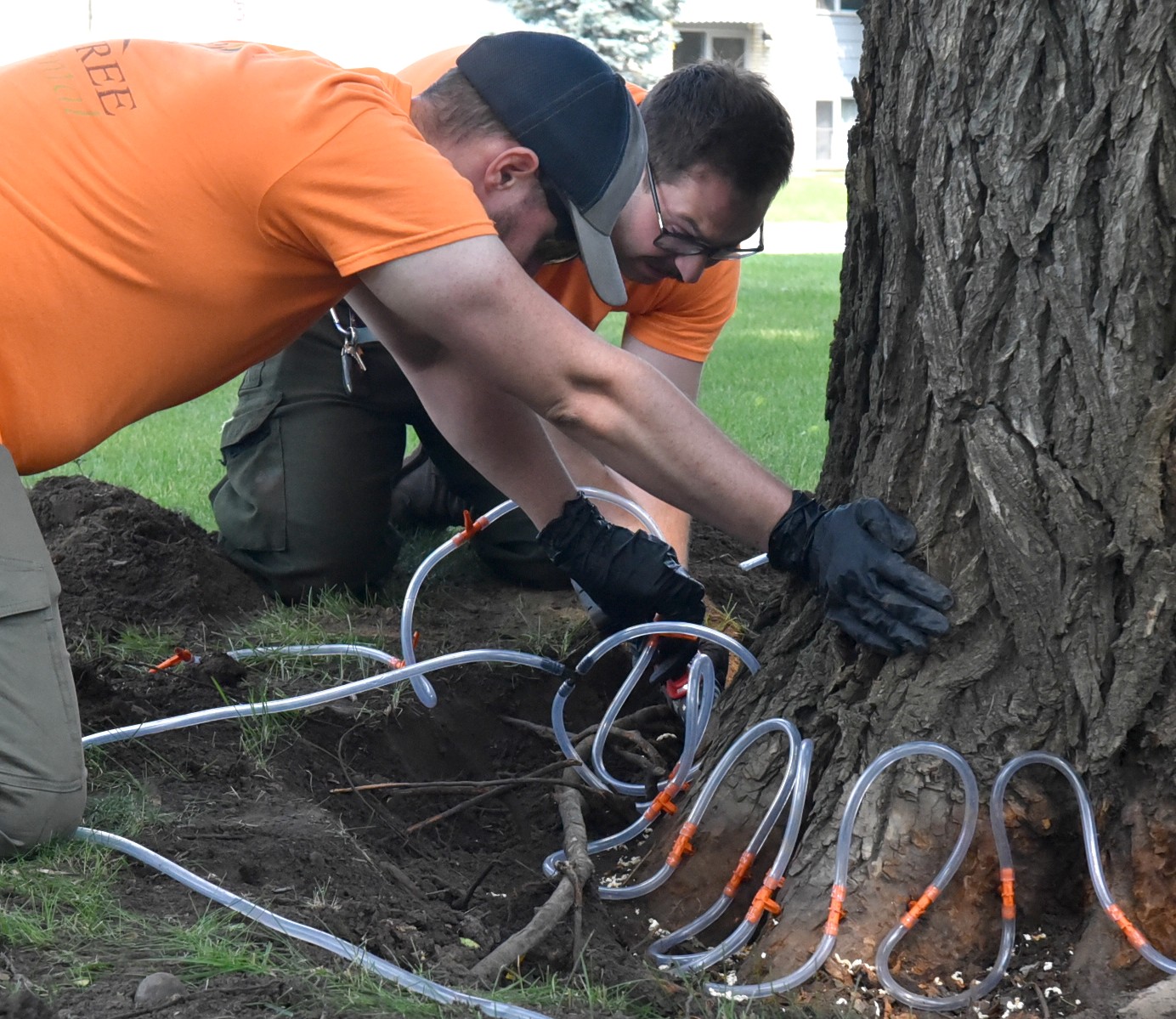
Hose is attached to each root using a drill after the root system is excavated to a certain dept. The two men can treat four or five trees per day, depending on the size of the tree.
Hose is attached to each root using a drill after the root system is excavated to a certain dept. The two men can treat four or five trees per day, depending on the size of the tree. (Image Credit: Susan McNeil/paNOW)

Prince Albert has a substantial American elm population and, while no confirmed cases have been found in the city, elm bark beetles in the province and the movement of firewood and other elm wood products remain an ongoing risk. 

At administrations recommendation, council appointed David Abramyk and Josh Hildebrand, both certified arborists, as Dutch elm disease municipal inspectors for the city. Both work for the city already so naming them as inspectors does not cost extra money.  

They are now responsible for monitoring compliance with provincial regulations, conducting inspections, overseeing elm pruning activities, ensuring elm wood is safely transported and disposed of, providing public education and helping coordinate an early response if a suspected case is identified. 

The Parks department has been conducting two Dutch Elm disease inspections per year, in the spring and fall, which Hale said is a good idea to catch any issues early.  

Treatment of trees is done with water, chemicals, some labour, and science.  

They start by excavating around the base of each tree so crews can inject the treatment below the dirt line. They measure the tree, calculate how much product and water are needed, then drill into the cambium layer and attach tubing around the trunk. 

A large tree can take three to four hours to take up more than 100 litres of water and solution, depending on the time of day, soil conditions, stress on the tree and even how sharp the drill bit is. 

Hale said the trees being treated are between 60 and 80 years old and have significant financial and social value. 

“These trees are anywhere, probably from $30,000 to $50,000 a tree,” he said. “They don’t grow overnight. To cut them down, you’re not only losing the social and economic value, you’re losing a lot of time as well.” 

Hale explained that figure reflects the cost of replacing a mature elm and the decades of shade, environmental benefits and community value that would be lost if it had to be removed.

This is the third year Living Tree Environmental has done injection work in Prince Albert. Hale said the company treated eight trees the first year, five last year and about 31 this year, mostly in the northwest corner of Kinsmen Park. 

The long-term goal, he said, is to build “stand immunity” by treating larger groups of elms rather than single trees. 

“Hopefully the goal, if Tim (Yeaman) ends up agreeing, is to eventually do the whole park and have Kinsmen Park have a stand immunity for Dutch elm disease,” Hale said. 


Marco Hale explains how the process of treating trees to prevent Dutch Elm disease at Prince Albert’s Kinsmen Park

The injections only apply to elm trees and are safe for the public once the work area around each tree is cleared. 

Prince Albert’s approach comes as other Saskatchewan communities continue to deal with more serious outbreaks. 

In Melfort, northeastNOW reported the city’s 2025 Dutch elm disease survey found 127 infected trees, including 73 on public land and 54 on private property. That was up from 102 infected trees in 2024 and 89 in 2023. 

Melfort removed all 73 infected trees on city property identified in 2025, though some infected private-property trees remained outstanding earlier this year. Melfort’s director of community services, Rob Lok, described the northeast as a “hot zone” for Dutch elm disease and said timely removal is key to getting ahead of the disease curve. 

Hale said the first step for any community is to look for the disease through regular surveys. 

“You can’t say you’re Dutch elm disease free if you’re not looking,” he said. 

He said communities that miss inspections can quickly fall behind, especially when infected trees are on private property and removal is delayed by cost or logistics. 

“Even one year off, if you think, ‘Oh, we don’t need a survey this year,’ that one year can just ramp your numbers up, and then you’re playing catch-up on those trees instead of trying to get ahead of the game,” Hale said. 

Symptoms can appear quickly. Hale said crews may find one symptomatic branch in mid-July and see the tree look much worse within a week or two. 

Homeowners should watch for yellowing leaves outside of fall, wilting branches, crispy green leaves and dead branches. Hale said the symptoms are often called “flagging” because one branch can stand out from the rest of the tree. 

The province’s elm pruning ban runs from April 1 to Aug. 31 each year to reduce the risk of attracting elm bark beetles to fresh cuts. Residents are also urged not to move or store elm firewood. 

susan.mcneil@pattisonmedia.com