Click here to sign up for our free daily newsletter.
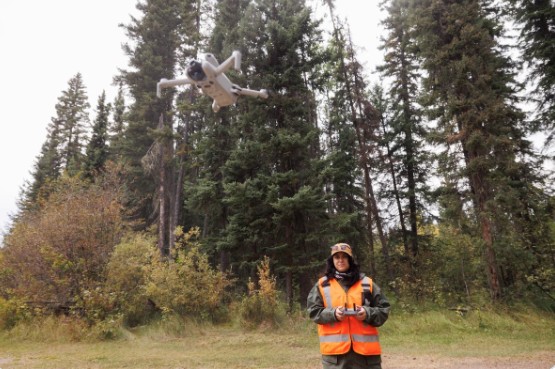
Researchers are using drones to help northern communities map things like homes and roads which can improve 911 response times and see the impact of disasters like wildfires. (Image Credit: submitted/SaskPolytech)
Multiple uses for data

Drone mapping offers faster, clearer picture for northern planning and emergency response 

Jul 2, 2026 | 3:18 PM

Drone mapping is giving northern communities a faster and more detailed way to keep track of roads, homes, infrastructure and natural resources, with Montreal Lake Cree Nation among the latest communities taking part in the technology.

Researchers from Saskatchewan Polytechnic were in the community in June collecting aerial images as part of a three-year project that combines drone data, satellite imagery and local training.

Abdul Raous, Sask. Polytech’s research chair in geospatial technologies, said communities need maps that reflect constant changes as new homes, roads and other infrastructure are built.

“Maps are not static. They are dynamic,” Raous said. “They keep changing because we keep having new infrastructure, new houses and new roads.”

Unlike satellites, drones can fly below cloud cover and collect high-resolution images whenever conditions are favourable.

“The biggest advantage of drones is that you can choose the time,” he said. “We fly below clouds, so there is no obstruction when we take those images.”

In Montreal Lake, researchers flew during the summer when longer daylight hours and snow-free conditions provided the clearest view of the community.

Raous said the team’s priority was documenting roads and recording the locations of community infrastructure, including homes and other buildings.

The information can be used to create digital maps that support community planning and improve emergency response, including meeting Next Generation 911 requirements by helping responders identify roads, buildings and other key assets.

The project also supports land and resource management. Researchers combine drone imagery with satellite data to map vegetation, water bodies and roads, while tracking changes caused by logging, wildfires and climate change.

Raous said satellites remain valuable because they cover large areas and provide historical imagery, while drones offer a much more detailed view of current conditions.

“The ultimate target is to help communities resolve whatever their issues are,” he said. “It could be environmental issues, mapping issues or management issues.”

One goal is to develop a dashboard that allows communities to quickly identify features such as forested land, water, roads and infrastructure, including fire hydrants, power lines and power poles.

Training is another key part of the project. Raous said community members are learning how to maintain and update the mapping system after the grant-funded work concludes, ensuring the information remains current as communities continue to grow.

During the recent visit to Montreal Lake, Sask. Polytech also provided introductory drone training for interested residents, including information that could help them obtain drone licences and support future search-and-rescue efforts.

The project is funded through a federal grant, meaning partner communities do not pay for Saskatchewan Polytechnic’s mapping, training or technical support.

Raous said seeing the technology produce practical benefits for communities is one of the most rewarding parts of the work.

“You are helping communities,” he said. “You feel that you are contributing for the betterment of society.”

paNOW reached out to Montreal Lake Cree Nation but did not receive a response before publication.

susan.mcneil@pattisonmedia.com