Click here to sign up for our free daily newsletter.
Community safety officers are part of the city's strategy to manage the public intoxication and drug use issues. (Image Credit: submitted photo/PA Police)
CSOs part of solution

Mobile complex needs team reshaping how Prince Albert Police respond, officials say 

Jun 17, 2026 | 4:01 PM

The mobile complex needs team is changing how Prince Albert Police respond to lower-level public disorder and substance-use related calls by giving police a more flexible, tiered approach, according to Chief Patrick Nogier. 

Nogier said the initiative has allowed them to respond to community concerns such as public intoxication and drug use in open spaces; often using the newly-expanded ranks of the Community Safety Officer (CSO) program. 

“It’s allowed us to respond to calls that the community has asked us to respond to without having to utilize frontline, heavily trained police officers to respond to a lower level,” Nogier said after a recent police board meeting. 

He said with the CSOs taking more public nuisance calls, full members have more flexibility and can answer other calls for service that previously might not have gotten the same response. The lack of capacity frustrated the public and officers alike.  

The mobile team is not designed as a traditional call-response unit. Nogier said that is intentional so the team can work proactively, deciding who to approach, where to engage and when intervention may help before a situation escalates. People who witness suspicious activity or an emergency are still being told to call the communications centre or 911, with police deciding whether a connection can be made to the mobile team. 

Anna Dinsdale, the city’s community safety and well-being co-ordinator, said the team is a partnership between police, Mobile Crisis, and Parkland Ambulance, with support from the city.  

Their method is to be more proactive and intensive while providing wraparound supports for people dealing with ongoing complex needs, including some who are intoxicated in the community but not necessarily unhoused. Team members distribute Naloxone, education on high risk substances, and connect the clients to support services and drive them for medical care.

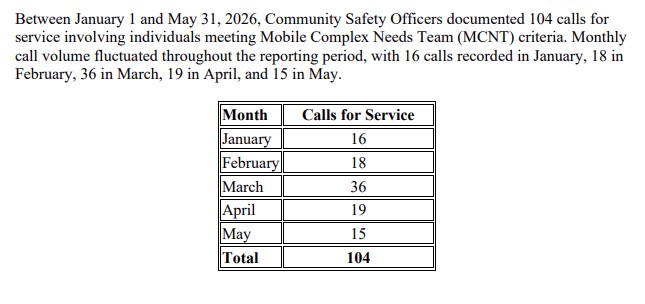
The team approach is to intensive and provide wrap around support where they can.
The team approach is to intensive and provide wrap around support where they can. (Image Credit: Agenda/PA Police Board of Commissioners)

The program has rolled out in phases, with the mobile crisis case management component operating since November and the community safety officers and ambulance component becoming operational in the new year. 

The team has connected with 127 people or more, which is more than half of the city’s homeless population.  

Dinsdale said the early results have gone beyond simply connecting people to emergency supports. 

“We’re not just seeing immediate benefits in terms of engaging people with more emergency services, diverting them from police cells or from the emergency department, but we’re also seeing surprising outcomes in terms of willingness and ability to engage with treatment services and referrals to treatment services,” she said. 

Dinsdale pointed to one case where staff helped bridge a person from detox to temporary housing, then to treatment and sober housing, saying that kind of continuity is unusual for someone who is unsheltered and shows the impact intensive support can have. 

Nogier said intoxication arrests and admissions to cells were up through May compared with 2025, a trend he described as concerning. He said community safety officers are a key part of the response because they are not tied directly to 911 call handling.  

The community safety officer program is now fully staffed with five officers and gives the service a tiered approach to policing. CSOs receive a different and faster training stream than sworn members, which helps them get in the field more quickly. 

The federal grant that helped launch the initiative runs until March 2027 and paid for major capital purchases (such as vans) up front.  

The city and its partners are now looking at how to sustain staffing beyond that date and have asked the University of Saskatchewan to conduct an independent evaluation of the program. 

The mobile team is being developed alongside the planned Complex Needs Shelter, which officials say will provide a safe and secure place for police to bring intoxicated people whose behaviour poses a danger to themselves or creates a public disturbance. Nogier said the combination of the shelter and the mobile team should eventually reduce lower-level intoxication arrests and change how police respond in those situations. 

The opening of the shelter (funded by the Province of Saskatchewan) has been pushed to the fall as the renovations have taken more effort than estimated at first.  

Nogier is asking residents to be patient as the new programs continue to roll out and as consultation continues on how best to build supports and wraparound services for Prince Albert. 

susan.mcneil@pattisonmedia.com