Click here to sign up for our free daily newsletter.
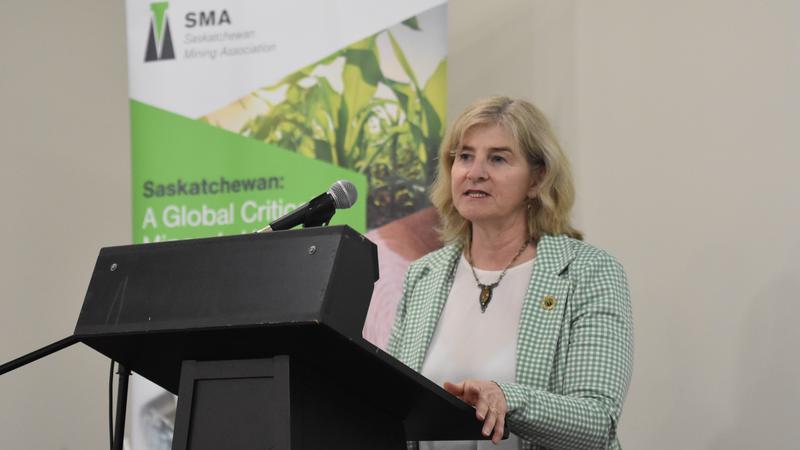
Saskatchewan Mining Association President Pam Schwann (Derek Craddock/paNOW Staff)
MINING

Future of mining in Sask. discussed at Chamber luncheon

Jun 1, 2023 | 5:16 PM

Standing in front of business owners in Prince Albert on Thursday, the President of the Saskatchewan Mining Association shared the success and future of the industry.

Pam Schwann discussed the past year for mining, focusing on several key areas including the continued demand for potash and uranium and the future of critical and rare earth metals in the province.

“We already have 23 of the 31 critical minerals that we need for clean energy and technology,” she said following her presentation. “We’re already global leaders in terms of potash, in uranium, but we’ve got emerging potential for things like copper, zinc, nickel, rare earth element deposits on top of our uranium.”

When it came to how northern Saskatchewan has contributed to the prosperity of mining, Schwann noted the restart of the McArthur River/Key Lake mine as well as future opportunities in places like the Foran Mine.
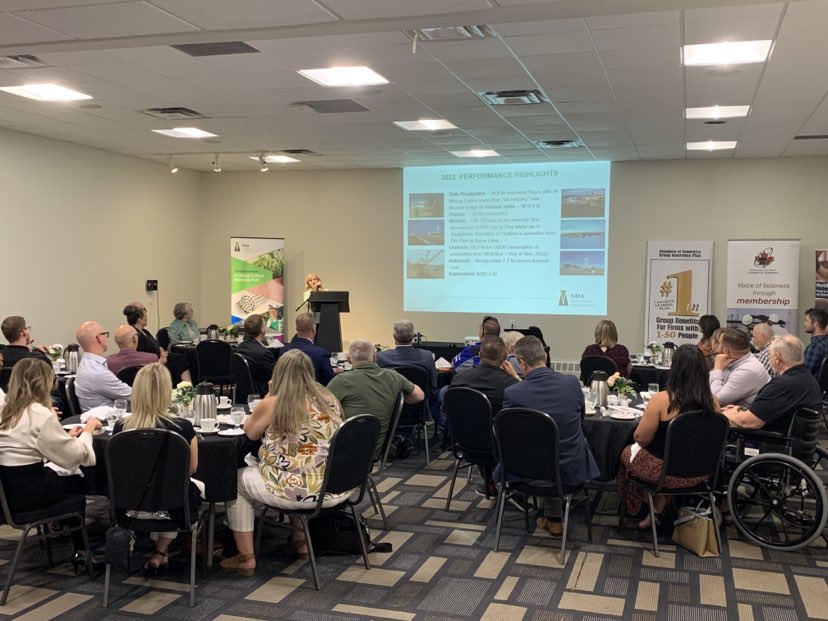
(Derek Craddock/paNOW Staff)

Schwann said there were some challenges in the market over the past year, which included sanctions against Russia and Belarus. However, those roadblocks drove potash prices up and made Saskatchewan a major supplier of uranium.

According to the SMA, mining companies contributed over $2 billion in provincial, federal and municipal taxes in 2021 while employing over 26,000 workers that year.

Uranium, meanwhile, contributed over $530 million in tax revenue and employed roughly 1,800 workers at five mines in northern Saskatchewan.

Schwann also used part of her presentation to talk about the industry’s climate plans, especially regarding nuclear energy.

Schwann stressed that the environmental impact of nuclear energy is quite low compared to other energy resources and systems and the environmental footprint is significantly less.

She added that while things like solar power can work in places like Saskatchewan with a large array of land, other markets don’t have that luxury.

“London, England, Singapore, all these places where you have so many people in a small area, (they) can’t realistically look at solar and wind that takes up so much space and don’t provide base load. You still need to back up, so nuclear provides the base load.”

Schwann also made mention of the province’s rare earth mineral strategy. Last August, the Saskatchewan Research Council (SRC), presented the first ingots of rare-earth metals produced in Saskatchewan. It plans to help create more of these metals as global demand is expected to double by 2030.

While the province is still working on its strategy for these elements, Indigenous leaders have argued that all rare earth elements and critical minerals in the province belong to First Nations and want to work with the province to create a resource revenue-sharing agreement.

-With files from 650 CKOM