Click here to sign up for our free daily newsletter.

Winter accessibility part two: limited resources in Regina

Dec 14, 2012 | 6:09 AM

During the winter, it can be almost impossible for people who are disabled or visually impaired to navigate through Regina's icy and snow-filled sidewalks. While winter tires may help gain traction on a vehicle, people in wheelchairs are often left stuck on the ice.

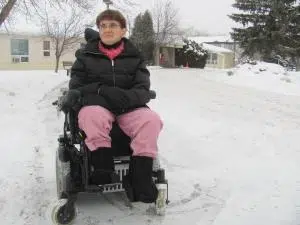
“I've found with my power chair, it can go through ice underneath snow. But it's not very easy,” said Charlene Eger. She was born with spina bifida and has spent her entire life in a wheelchair. Winters in Regina carry the same challenges every year for the woman, who uses a motorized chair whenever she ventures outside.

“(Getting around in Regina in winter is) not good because of snow removal.” Like some of Regina's visually-impaired citizens, Eger finds that the way Regina clears the streets leaves snow in the sidewalks, creating obstacles for her. Not only will her wheelchair get caught in the snow on the sidewalks, snow left of the curbs means she often can't cross the street in her chair.

Eger relies on city transit to travel around Regina. However, the only bus stop that can access the low-floor bus service the city offers is two blocks from Eger's home in north Regina. At times, she can't maneuver her chair to reach the bus stop, or the snow on the sidewalks prevents her chair from being able to roll onto the bus.


“The only other option is paratransit.” However, Eger must carefully plan out all of her rides, maintaining that unless she phones the service one week in advance, she cannot be confident in being able to book a ride.

“She is not incorrect in saying that,” said Lynette Griffin, manager of the City of Regina's transit operations and accessibility, “because our resources are limited and there is a high demand.” Griffin says that paratransit's ridership stays at a consistent level year-round with a moderate increase during the winter. Although the city tries to increase service during that time, all they can provide is a 10 percent boost.

“Unfortunately the demand for our services exceeds our available resources. We have many people that call us for trips that we cannot accommodate .” Paratransit has made some changes to try and increase service, including limiting people to booking trips only one week in advance. Griffin says they are also working with other paratransit providers in Saskatchewan to learn how they can be more efficient.

“I would like to see one of those dump trucks load the snow in there,” Eger said when asked about what needs to happen to make Regina more accessible for her.

Jamie McKenzie agrees. The wheelchair user used to live in Saskatoon where there is a sidewalk-clearing bylaw.

“People don't want to be fined for not shovelling their sidewalks. So other people will help them if they can't clear the sidewalks…and the city needs to give out fines for that so people are determined to clear their sidewalks.”

McKenzie takes regular transit in Regina year-round, though he admits it isn't easy. He takes an extra route to the University of Regina campus to transfer to another bus if he wants to go downtown, because that's the only way he can access the service. McKenzie adds that even though he can get on to the city's buses with that method, it doesn't mean he can always get off them.

“It happened on Grey Cup Sunday. I went to the Golden Mile Mall, and there was a big snow bank in the back where the buses drop you off. They piled all the snow against the wheelchair ramp that takes you up into the Golden Mile.” McKenzie had to get the help of the bus driver and two other people on the bus to push his chair out, and onto the city's streets.

news@panow.com

Twitter: @princealbertnow