Click here to sign up for our free daily newsletter.
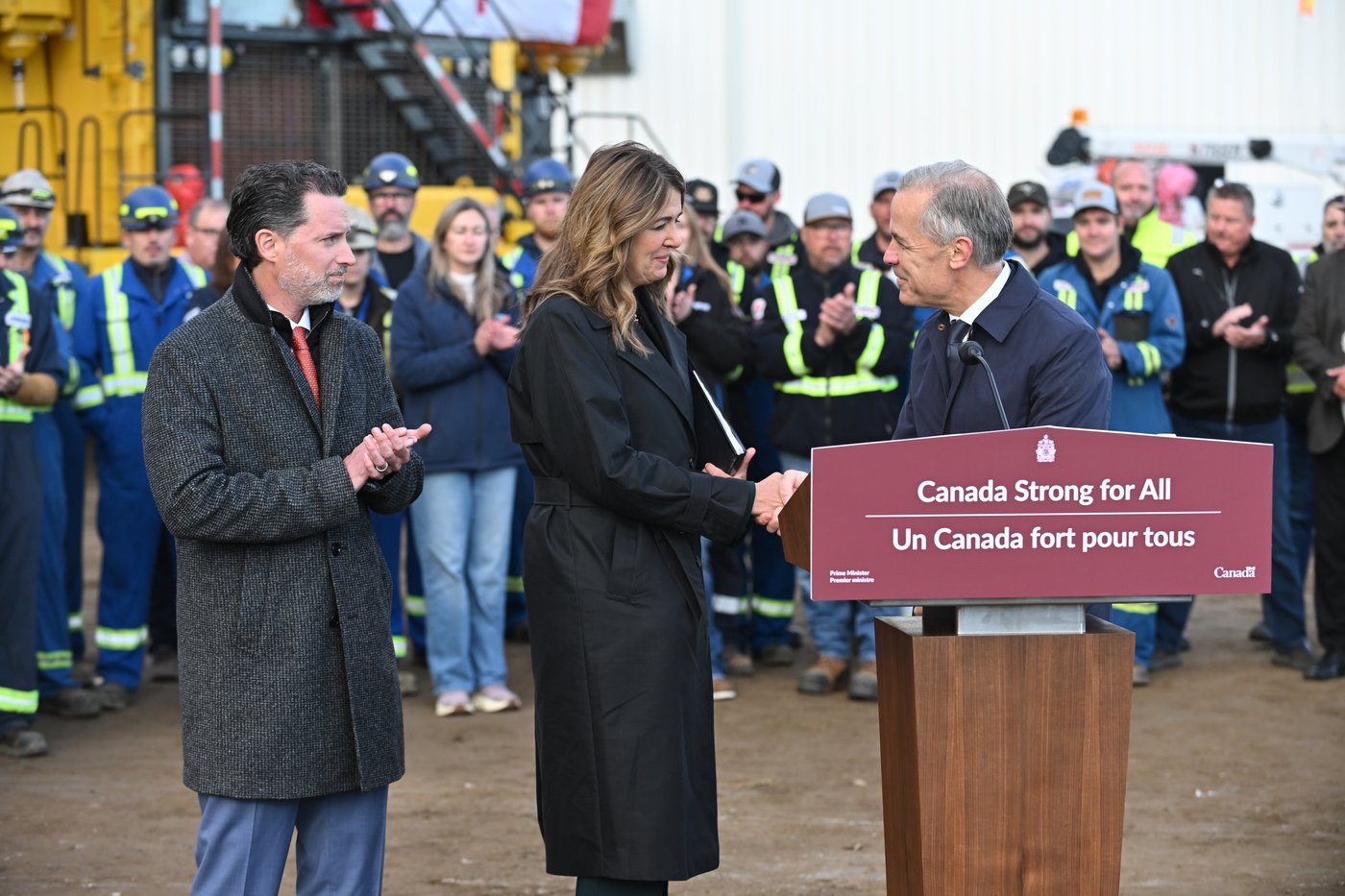
From left, Scott Burrows, CEO of the Pembina Pipeline Corp, Alberta Premier Danielle Smith and Prime Minister Mark Carney shake hands after speaking in Fort McMurray on Thursday Oct 1, 2026. Prime Minister Mark Carney declared the Pacific Link pipeline project to be in the national interest. THE CANADIAN PRESS/Greg Halinda

QuickQuotes: Reaction to the Pacific Link pipeline project

Oct 1, 2026 | 12:58 PM

OTTAWA — Prime Minister Mark Carney announced Thursday that the Pacific Link pipeline project is the first to be designated a project in the national interest under the Building Canada Act.

The designation allows the federal government to streamline the rules and timelines for project approvals, with a goal of completing the required consultation, environmental assessments, financing and Indigenous partnerships by next September.

Here is what’s being said in response:

“We have to do this because the world’s facing an energy crisis on three dimensions. There’s an immediate challenge of affordability, and in some countries, the very availability of hydrocarbons. There’s a structural challenge of energy security and the existential challenge of climate change. And these challenges are forcing countries to think differently about where their energy comes from and who they can rely on to supply it. Global oil demand is around 100 million barrels a day … Global oil supply is often now impacted by conflicts, and it’s becoming more volatile, and while the precise path ahead is always uncertain, oil demand will continue to be significant for decades to come.”


— Prime Minister Mark Carney

––—

“This is a monumental day for our province and for our country. It is also an important step towards our goal of securing the necessary approvals and conditions for design and construction to begin as early as Sept. 1, 2027, turning this project from a vision into a reality. Today sends a clear message: Canada is ready to build. Canada possesses some of the world’s largest energy reserves, a highly skilled workforce and an impressive track record of responsible resource development after decades as a major global energy producer.”

— Alberta Premier Danielle Smith

––—

“This announcement today shows that when you have our provincial government and our federal government working in the same direction, big things are going to happen. When Fort McMurray does well, Alberta does well. And when Alberta does well, Canada does well.”

— Regional Municipality of Wood Buffalo Mayor Sandy Bowman

––—

“We strongly support a new pipeline to the Pacific and congratulate Premier Smith for championing this project. It has taken Mark Carney almost a year and a half to put one proposal on a national interest list. We need a pipeline in the ground, not just on a list. Meanwhile, 500 projects are sitting on the prime minister’s desk waiting for federal approval behind a wall of taxes and bureaucracy. These governmental obstacles mean that this otherwise-profitable Pacific pipeline project requires billions of tax dollars to get built. The federal government needs to get out of the way and let builders build, investors invest, and workers work, which would remove the need for tax-funded subsidies.”

— Conservative Leader Pierre Poilievre

––—

“This project leaves Canadians bearing all the risks of a bad investment without any of the rewards. The industry itself is unwilling to finance this project. Indigenous nations have expressed opposition. And the environmental and climate consequences are extreme, including the threat to endangered Southern Resident orcas. This is a pipeline to the courts, and it’s not worth the risk. Projects that truly serve the national interest would lower costs, create good jobs, and protect the people and places we love — like renewable energy projects, 21st-century public transit systems to connect our communities, and a massive build-out of non-market housing Canadians can actually afford.”

— NDP Leader Avi Lewis

––—

“Today’s designation is an important step toward providing the certainty needed to advance this major nation-building project that can deliver lasting economic benefits for communities across the country, including 140,000 jobs, $20 billion per year in GDP, $100 billion in government revenue by 2060, and unlock Canada’s full energy potential.”

— Lisa Baiton, president and CEO, Canadian Association of Petroleum Producers

––—

“Getting our resources to Asia-Pacific markets is a path to more production, prosperity and a brighter future for workers, their families and communities. This path will strengthen Canada’s role on the world stage, connecting our resources with new customers while helping support the stability and resilience of global supply chains, and reinforcing our reputation as a trusted partner to our allies. I also want to commend the government’s meaningful focus on regulatory certainty and attracting private capital through this action, helping to answer some of the missing links identified in our recent Beyond Potential report with PwC Canada.”

— Bryan Detchou, senior director of natural resources, environment and sustainability for the Canadian Chamber of Commerce

––—

“The only thing moving faster than the prime minister’s bulldozing of environmental laws and Indigenous rights is the unprecedented speed with which our would-be future customers in Europe and Asia are building solar power and wind farms to protect themselves against increasingly unreliable and conflict-ridden oil and gas imports. In the wake of the wars in Ukraine and Iran, oil and gas are recognized as a source of overwhelming economic, environmental and geopolitical risk, so why would the government of Canada willingly burden all of us with a $40-billion taxpayer-funded pipeline? Renewable energy is faster and cheaper to build, and more beneficial for our communities.”

— Keith Stewart, senior energy specialist with Greenpeace Canada

––—

“The West Coast pipeline project will have big impacts on the Salish Sea — one of the world’s most productive inland marine ecosystems — increasing shipping noise, pollution, and destroying estuary habitat. Routine operation of the marine terminal at Roberts Bank will have big impacts on salmon, migratory birds and could push the Southern Resident Killer Whale further towards extinction. But a spill or accident involving the proposed very large crude carriers would be catastrophic for the entire region.”

— Margot Venton, lawyer and nature director at Ecojustice

This report by The Canadian Press was first published Oct. 1, 2026.

The Canadian Press