Click here to sign up for our free daily newsletter.

Wind chills have no effect on mountain pine beetle

Jan 23, 2014 | 5:04 AM

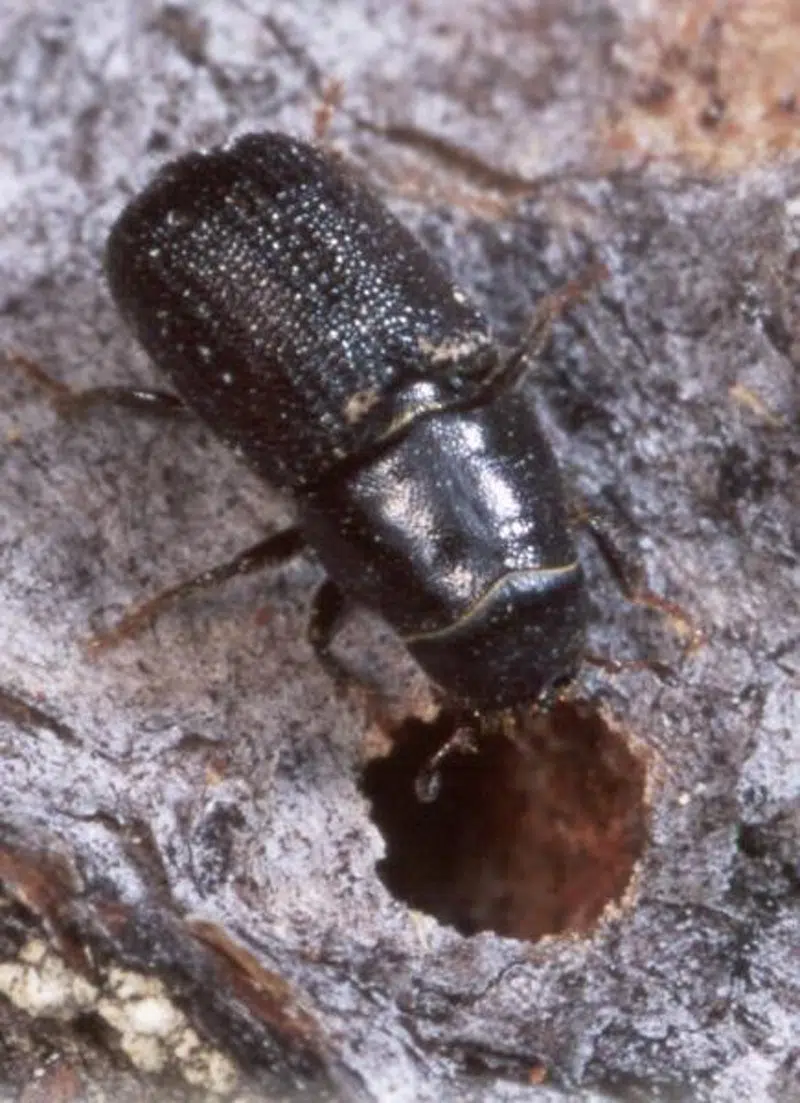
The number of mountain pine beetles (MPB) in Saskatchewan may be on the decline at the moment but the cold weather this winter is having no real effect on the insect.

The MPB is the natural enemy of lodge pole pine trees and had devastated more than 18 million hectares of lodge pole pine trees in B.C. already.

The MPB is migrating from B.C. and can be found in Albert and in the Cypress Hills region in Saskatchewan.

Dr. Rory McIntosh, a provincial forest entomologist and pathologist for the Saskatchewan Ministry of Environment, said there are only about 10 or 12 trees in the Cypress Hills area that are infected, which is less than last year.

McIntosh said this winter it hasn’t been cold enough, for long enough, to have a real significant effect on the MPB numbers in the province.

“It’s a very difficult one to assess because it’s quite highly variable in the effects that it has on the beetle,” he said.

When it comes to the spread of the beetle, McIntosh said “it’s better to have these -30 [degree] to -40 [degree] temperatures, even for just a short time than to have a very mild winter. The winter will help but it won’t be sufficient to collapse populations per se.”

McIntosh said he did an assessment looking at minimum temperatures for the areas of major concern, which would be Fort McMurray and Slave Lake in Alberta and the Cypress Hills region in Saskatchewan.

“It only reached -41 [degrees] one day in Fort McMurray this winter. Similarly in Slave Lake, the coldest day they’ve achieved so far is -34 [degrees], in Prince Albert on New Year’s Eve we got -41 [degrees]. So, those lethal temperatures just haven’t been reached at this point in time,” McIntosh explained.

“One of the things we tend to forget is that often these temperatures are reported as wind chills and the wind chills have an inflationary effect on the cold … and of course for insects and beetle wind chills aren’t effective at all, it doesn’t make a difference what the wind chill is.”

He said it’s the temperature under the bark of the tree that really count.

Despite the weather, McIntosh said there is still a concern of the beetle making its way into more of the province. 

“The beetle is still within 50 kilometres of our border, so we’re still on high alert and we’re continuing to work collaboratively with the government of Alberta to reduce or at least focus our control actions in areas of most concern to Saskatchewan in eastern Alberta,” McIntosh said. 

One way they are controlling the spread is through fall and burn action, where infected trees are cut down and burned.

“Concerns with the temperatures, that’s one of the big questions we get asked every year and the answers aren’t very clear. We’ve continued to assist and support research to understand the impacts of lethal temperatures on the beetle’s survival,” he said.

“As the beetle moves into new habitat like the Jack pine forest in the boreal Jack pine, the traditional knowledge about how beetles behave is really being reestablished, the beetles are behaving differently, so it’s not the same as just looking at how it looked in B.C. or western Alberta and saying it will behave the same in eastern Alberta or in the boreal forest, there are a lot of uncertainties we’re working on trying to understand better.” 

swallace@panow.com

On Twitter: @sarahthesquid