Click here to sign up for our free daily newsletter.
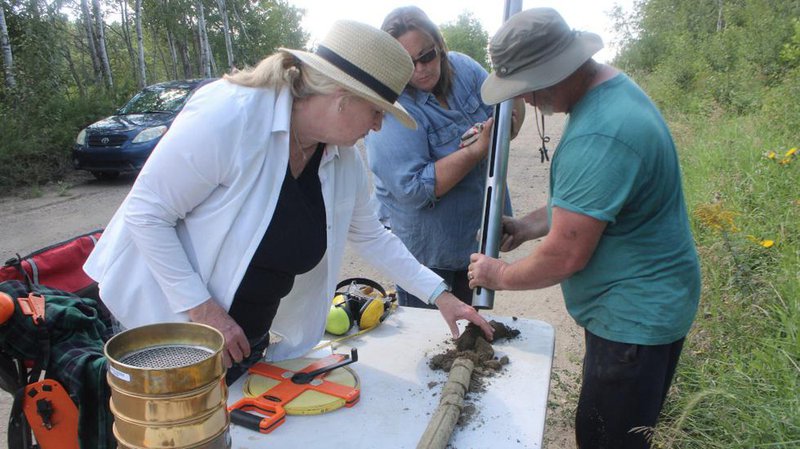
Dr. Andrea Freeman, Dave Rondeau and Melanie Markling examine a core sample. (Nigel Maxwell/ paNOW Staff)
Digging up the past

WATCH: Research team investigates potential size of Prince Albert area archaeological site

Jul 29, 2025 | 5:00 PM

Just over a year since an archaeological dig unearthed a near 11,000 year old bison bone, proving the existence of a human occupation, a team of researchers and volunteers have returned to the site west of Prince Albert.

The central purpose of this week’s expedition is to figure out the exact size of the site.

Dr. Glenn Stuart, an associate professor in the department of anthropology at the University of Saskatchewan, noted the provincial importance of last year’s discovery.

“To properly protect the site, we need to know how big it is and where it is so we can then try to keep forestry, for example, farther away,” he said.

Noting the presence of a coring rig and some shuttle tests that will provide more information about the stratography, Stuart said each flake they find (remnants from old tools that were used) represents a sort of marker and allows them to move further back into the bush. And while noting the archaeological importance of their work, Stuart also expressed his personal excitement about the potential educational opportunities for local indigenous youth.

Dr. Glenn Stuart discusses their local partnerships. (Nigel Maxwell/ paNOW Staff)

This week’s work which was preceded by a pipe ceremony and meeting with local elders is about balance – and Stuart – who acknowledged the destructive nature of archaeology – said they are taking every precaution possible to explore the site, while using the least amount of disturbance.

Dr. Andrea Freeman, a geo-archaeologist from the University of Calgary, has a background in river systems and how they move materials about and how they preserve materials.

“So this is exciting to me from that standpoint, from just understanding how this river was operating in the past, but also the human component of it too and my hope also is that we would find many layers of occupation, not just the one that we know about, but subsequent layers that will tell us that people have been here for thousands of years,” she said.

Dave Rondeau demonstrates how the coring drill works. (Nigel Maxwell/ paNOW Staff)

Freeman points to a drill rig that will take a very small core sample from the ground. The sample, which in some respects resembles cookie dough, allows the researchers to look artifacts. 


“We can look for the same kinds of sediments that we were finding before that has the occupation level on it and determine where the boundaries of that feature are and also where the boundaries of the site are,” she explained.

Bailey Pelletier, a young archaeologist from Saskatoon, is volunteering to do some shovel testing and described the experience as amazing.

“Especially as an Indigenous archaeologist, seeing how community-oriented it is out here has been so beautiful to see, because it’s still a struggle a bit sometimes between archaeologists and Indigenous communities. So seeing it come together and working together and like bridging that gap and making collaborations has been amazing.”

Pelletier explains her work. (Nigel Maxwell/ paNOW Staff)

On Monday, more than 70 people came out for the pipe ceremony and included representation from Sturgeon Lake and Big River First Nations, as well as Wahpeton Dakota Nation.

Elders were provided a full description of not only what was happening this week but also what future plans involved.

Freeman noted they have received enormous support and thanked all the communities involved.

nigel.maxwell@pattisonmedia.com

On Blue Sky: @nigelmaxwell.bsky.social