Click here to sign up for our free daily newsletter.
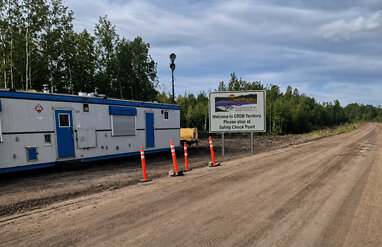
The Clearwater River Dene Nation's Highway 955 safety checkpoint is now operating north of La Loche. The checkpoint is intended to improve safety and communication around increasing industrial activity in CRDN's traditional territory, including NexGen Energy's Rook 1 Project - a major underground uranium development located in the southwestern Athabasca Basin, about 150 kilometres north of La Loche. (Image Credit: NexGen Energy Ltd./Facebook)
expanding industry

Highway 955 checkpoint comes as uranium boom creates opportunities in northern Sask.

Aug 26, 2026 | 6:01 AM

The uranium boom unfolding north of La Loche is already creating new employment and training opportunities for members of the Clearwater River Dene Nation (CRDN).

Chief Teddy Clark told larongeNOW the pace of activity in the region has increased significantly, with multiple companies exploring for uranium and construction now underway at NexGen Energy’s Rook I project.

“There has been a good significant amount of employment given out within the preparation of the mine coming up,” Clark said.

“I’m not sure exactly what percentage, but there is a good amount of people working up there now than I’ve ever seen before.”

The Canadian Nuclear Safety Commission approved a licence for site preparation and construction at Rook I in March. Construction activities began in June at the proposed uranium mine, which is located about 155 kilometres north of La Loche.

The project is one part of a broader increase in industrial activity in the western Athabasca Basin.

Clark said companies including F4 Uranium, F3 Uranium, Standard Uranium, IsoEnergy and Cameco are active in the region. He also said BHP has recently acquired land and could potentially undertake work there in the future.

The increased activity is prompting some CRDN members to pursue training for jobs connected to the industry. Clark said most of that training has been short-term, while some members have pursued longer-term education in areas such as environmental monitoring and geotechnical work. Much of the current work involves heavy equipment operation, including assisting geologists with core logging. He added some members also came into the current mining boom with training and experience in areas such as housekeeping and cooking.

While CRDN sees economic opportunities in the growing industry, Clark said the Nation is not prepared to simply give every company the green light.

“We are open to an extent,” he said. “We cannot just say yes, go ahead to every, every, every company.”

The Nation wants to know what companies are doing, where they are working and what the potential impacts could be on the land and on people who continue to use the territory.

“Those are things that need to be considered very carefully before we start saying yes, go ahead, we’re fine with it,” Clark said.

The growth in activity is also behind a new Highway 955 checkpoint that began operating Tuesday on CRDN reserve land north of La Loche.

John Desjarlais, an engagement specialist with CRDN, said the Nation had encountered situations where land users did not have a clear process for knowing who was operating in the area.

“There’s been an increase of activity, certainly in the northwestern area,” De Jarlais said. “And then several instances where I think land users were using their land and there was no kind of clear process around notification with local authorities, with local government, who’s using what and how and whatnot.”

He said the checkpoint is intended to establish a process for tracking who is moving through the area and help build relationships with industry and other authorities.

“And so that we can, again, properly mitigate and then build a deeper relationships with the people coming and going and then understand what’s happening,” De Jarlais said.

The Hwy 955 checkpoint began operating on Tuesday, Aug. 25, 2026.

Clark said heavy trucks and other industrial traffic travelling north will be asked to check in and provide information about where they are going and what they are doing. That information can then be shared with CRDN members who are travelling or spending time on the land.

“A lot of people do not own two-way radios or the means to communicate with traffic going up and down the 955,” Clark said.

Desjarlais said the checkpoint is not intended to signal opposition to resource development.

“The nation is absolutely not opposed to development,” he said. “They have incredible relationships with some industry proponent, most industry proponent developers, explorers.”

For CRDN, Clark said the challenge now is making sure the economic benefits of the expanding industry are matched by meaningful engagement and consideration of the Nation’s lands and its members.

“There’s a lot of economic development benefits that need to be acquired,” he said.

Clark expects industrial activity in the region to continue increasing as projects progress, but said CRDN will continue to assess development on a company-by-company basis.

“We need to sit down, we need to engage,” he said.

teena.monteleone@pattisonmedia.com