Click here to sign up for our free daily newsletter.

What those different versions of the Iranian flag appearing at protests mean

Mar 5, 2026 | 1:13 PM

TORONTO — As protests ramp up around the world in response to the U.S.-Israel war on Iran, different versions of the country’s flag are appearing on the streets.

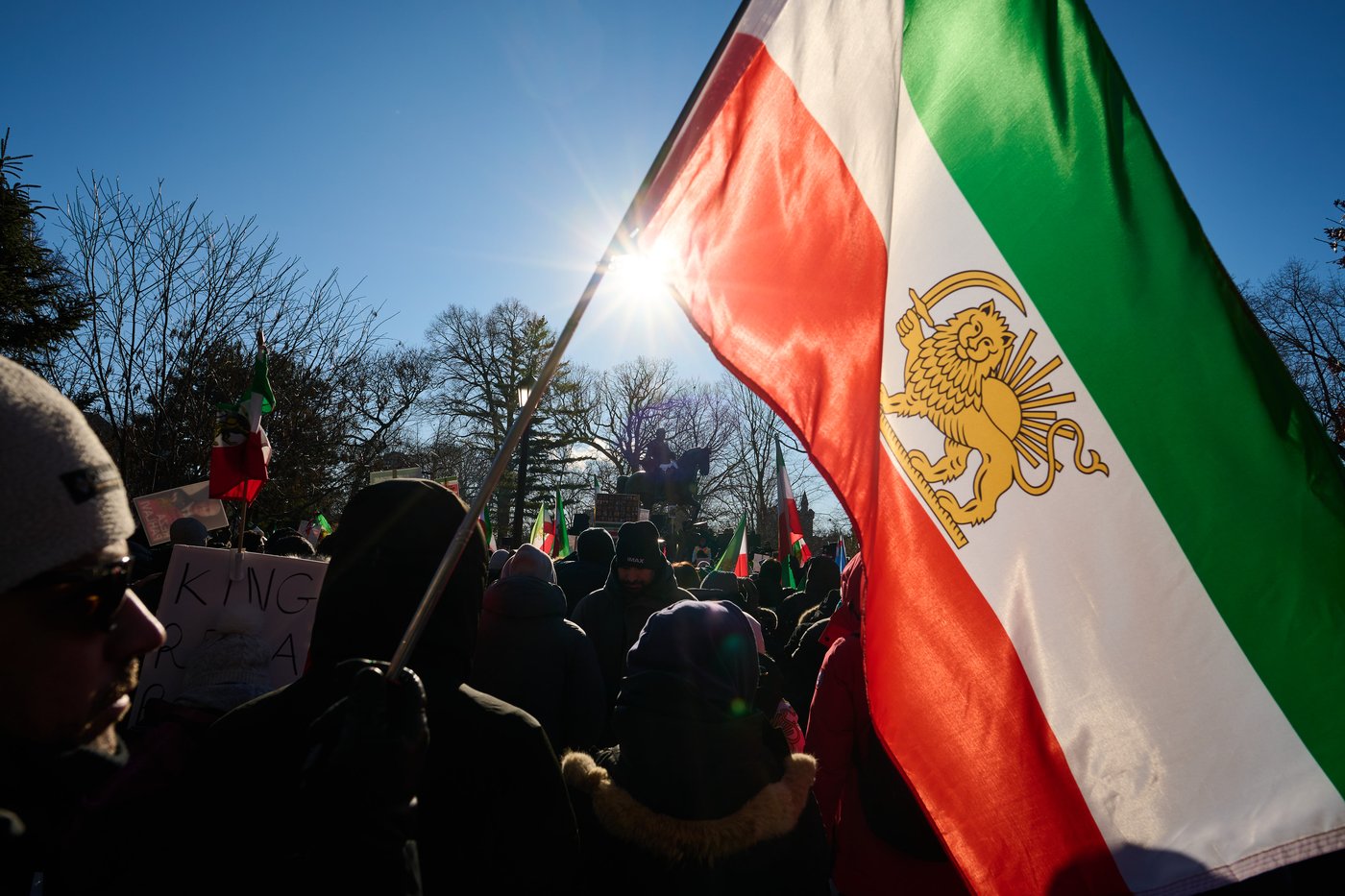
Both Iran’s official state flag and the historic “Lion and Sun” flag have become common sights at rallies.

The official flag, which represents the current regime, features a red emblem meaning “Allah” in the centre. It was adopted in 1980, the year after the Islamic Revolution led by Ayatollah Ruhollah Khomeini toppled the monarchy of Shah Mohammed Reza Pahlavi.

Like all other versions, the official flag features three horizontal bands of green, white and red, representing Islamic faith, peace and valour, respectively.


Around the inner borders of the top and bottom bands, a Kufic script reads, “Allahu akbar,” meaning, “God is great.”

Dr. Shirin Khayambashi, an assistant professor in the sociology department at Toronto Metropolitan University, said the official flag is a controversial symbol of the regime and is rarely seen at protests in the diaspora.

“The Allah emblem definitely represents the Islamic Republic of Iran,” Khayambashi said. “It has been something that caused anger and frustration for the Iranian community and it’s a rarity to see during the protests.”

Khayambashi, who lived in Iran until the age of 14 before moving to Canada, has extensively studied the experiences of immigrants in diasporas, in particular those within her community.

Her 2019 research paper “My Flag, My Identity: Fragmented Identities in Iranian Diaspora” explores the history of the country’s flag and the contested nature of its political and religious symbolism.

Before the “Allah” emblem was introduced, the flag used to carry an image of a sun and a lion at its centre. That pre-revolution flag is now one of the most widely seen at protests, Khayambashi said.

The sun and the lion flag dates from the early part of the last century. It was adopted as the national flag under Iran’s 1906 constitution and was recognized throughout the Qajar and Pahlavi dynasties before being strictly banned under the current regime.

“The lion and the sun in the middle was supposed to be representative of the people of Iran,” Khayambashi said.

She said that flag is widely associated today with support for the former monarchy and is often seen at rallies side by side with posters bearing slogans like “Bring Reza Pahlavi back” and “Make Iran Great Again.”

“When people go to the protests under the lion and the sun flag, it’s no longer representing the people of Iran. It’s representing a very specific political view, which is monarchy and revival of a king that was removed,” Khayambashi said.

Today, she said, the flag represents a “clear divide” in the Iranian diaspora as it becomes increasingly associated with Israeli and American flags at protests — something the antiwar element of the Iranian diaspora rejects.

Other variations of the Iranian flag include the army flag and the tricolour flag.

The army flag features the sun and lion emblem but has an added wreath and crown.

The tricolour flag, also known as the white flag, has no emblem in the centre. Khayambashi said it is referred to as the “flag of the people” because it represents no regime and can be customized with an emblem to represent a particular cause or movement.

“We have had diversity of flags over time. The three colours remain, but the emblem has been very important for people to kind express themselves and identify with their national identity,” she said.

The tricolour flag was seen during protests in support of the Woman, Life, Freedom movement, which emerged in 2022 following the death of 22-year-old Mahsa Amini in the custody of the country’s morality police and the subsequent brutal crackdown by the Iranian government.

The movement’s flag features the tricolour flag with the words “Women Life Freedom” in either Kufic or English script in the centre.

This report by The Canadian Press was first published March 5, 2026

Fatima Raza, The Canadian Press