Click here to sign up for our free daily newsletter.
(Image Credit: The Canadian Press)
Feb. 24, 2022

‘You just get used to it’: Four years after fleeing war, a displaced Ukrainian reflects on life in Saskatchewan

Feb 23, 2026 | 4:01 PM

Nearly four years after fleeing Ukraine, Yevheniia Pyshuk has built a life in Saskatchewan, but every call home still begins with uncertainty.

Her family remains in the country. She is the only one who came to Canada.

“Mentally, I think … you just get used to it,” she said. “It has already become part of the understanding. It’s already a part of the norm.”

As Tuesday marks the fourth anniversary of Russia’s full-scale invasion – a conflict widely described as Europe’s largest since the Second World War – Ukrainians across Canada are reflecting not only on the war’s toll abroad, but on the futures they are trying to shape far from home.

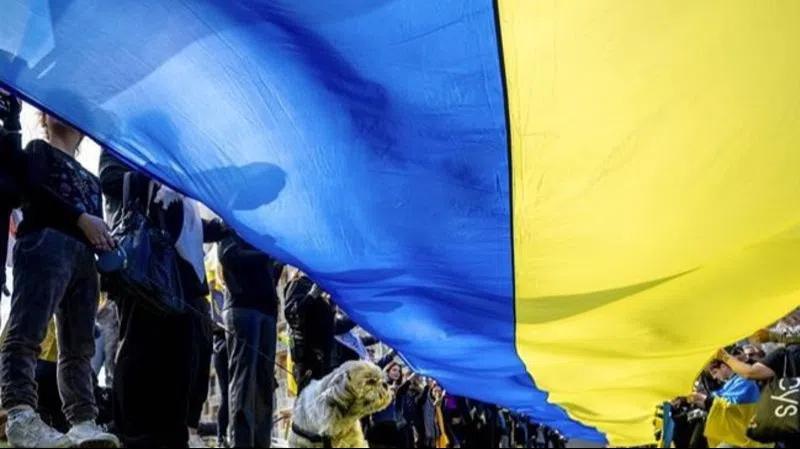
Russian President Vladimir Putin ordered the invasion of Ukraine on Feb. 24, 2022, a move widely seen as an attempt to reassert Moscow’s influence, block Ukraine’s closer integration with the North Atlantic Treaty Organization (NATO) and the West, and reinforce Russia’s claim over what it considers historically linked territory.

A war measured in distance and silence

The invasion has killed at least 15,000 civilians, according to the United Nations, while a U.S.-based think tank estimates as many as 1.8 million soldiers have been killed, injured, or gone missing on both sides.

Another analysis suggests Russia now controls nearly 20 per cent of Ukrainian territory.

For Pyshuk, those are not just numbers.

“Sometimes you’re calling them … you can hear in the background, like the bombings, explosions,” she said of conversations with her family.

“It’s terrible.”

When electricity cuts out or air raid sirens force people underground, hours can pass without contact.

“Of course, you feel fear, but you just keep on texting, and you just wait for one text message,” she said. “Once somebody responds, it’s all good.”

She describes the war as “saddening” and “frustrating,” adding, “It’s a big trauma for the whole Ukrainian nation.”

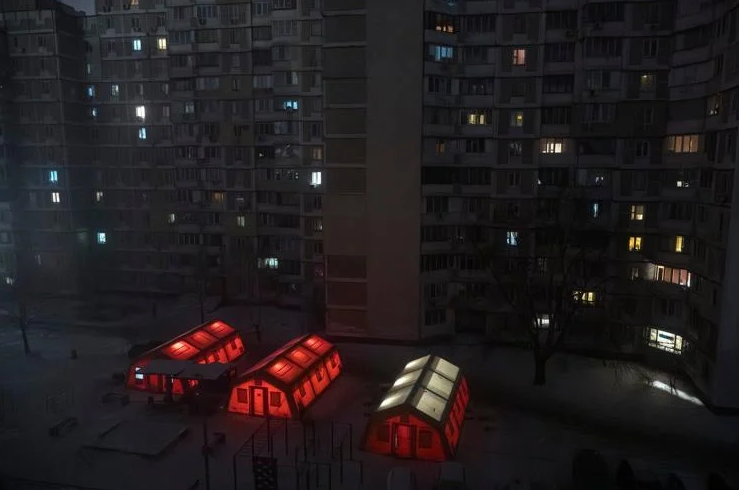
Emergency tents are set up in a residential neighborhood where people can warm up following Russia's regular air attacks against the country's energy infrastructure that leave residents without power, water and heating in the dead of winter, in Kyiv, Ukraine, Thursday, Jan. 15, 2026.
Emergency tents are set up in a residential neighborhood where people can warm up following Russia’s regular air attacks against the country’s energy infrastructure that leave residents without power, water and heating in the dead of winter, in Kyiv, Ukraine, Thursday, Jan. 15, 2026. (Image Credit: AP Photo/Vladyslav Musilenko)

Rebuilding on the Prairies

Pyshuk arrived in Canada three years ago under the federal government’s Canada-Ukraine Authorization for Emergency Travel (CUAET) program. She has spent the past two years in North Battleford.

“Ukrainians adjusted very well to Canadian culture,” she said. “Ukrainians are always expressing gratitude to Canadians for all the support that was provided by the government.”

Many newcomers, she said, have found work and enrolled their children in school.

“They already totally adjusted to Canada …and they love Canadian culture,” she said. 

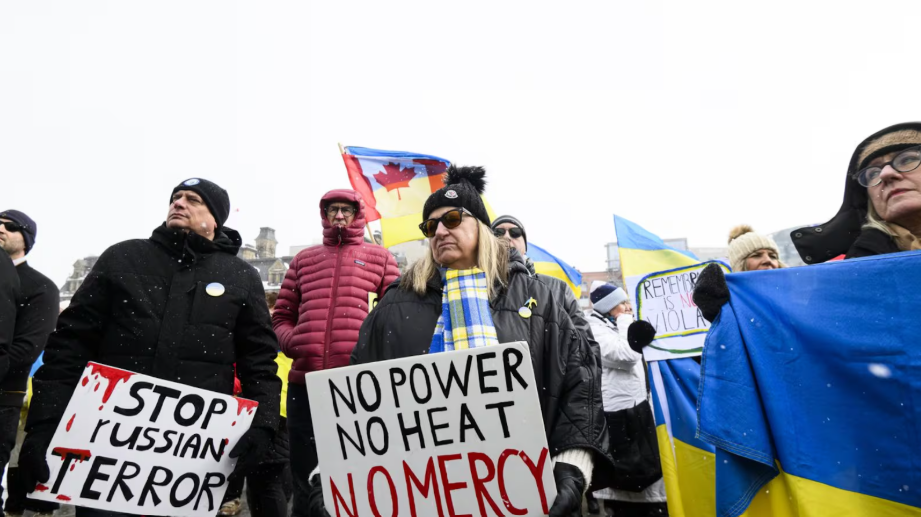
Across the country, public demonstrations this week have marked the anniversary. About 300 people gathered on Parliament Hill in Ottawa as the Ukrainian Canadian Congress commemorated four years since the invasion, one of 60 events planned nationwide.

Meanwhile, the Canada-Ukraine Foundation says it has raised more than $100 million for humanitarian aid but wants Ottawa to match donations as demand for food, medical equipment and generators continues.

Pro-Ukrainian demonstrators take part in a rally on Parliament Hill in Ottawa on Sunday, Feb. 22, 2026. Tuesday marks four years since Russia began its full-scale invasion of Ukraine.
Pro-Ukrainian demonstrators take part in a rally on Parliament Hill in Ottawa on Sunday, Feb. 22, 2026. Tuesday marks four years since Russia began its full-scale invasion of Ukraine. (Image Credit: THE CANADIAN PRESS/Spencer Colby)

Gratitude, but uncertainty

While Canada offered refuge, Pyshuk says many Ukrainians now face an uncertain immigration future as temporary work permits approach expiry.

Some qualify for permanent residency through family or employment pathways. Others do not.

“They already totally settled,” she said. “They love North Battleford, they love Saskatchewan. They have their kids studying here. They are already employed. They enjoy their jobs.”

Yet without permanent status, some may eventually have to leave.

“Sometimes there is even no home to come back to,” she said, noting that eastern parts of Ukraine have been heavily destroyed.

Her concerns echo those heard across Saskatchewan’s Ukrainian community.

“I think it’s important that we recognize that they’re actually not immigrants,” said Danylo Puderak, executive director of the Ukrainian Canadian Congress of Saskatchewan. 

“The Ukrainians that are here are here because of an invasion that Russia launched four years ago.”

He said those who arrived did so under the CUAET program, created to help people displaced by the war.

“This program was to assist displaced Ukrainians, and that’s really who they are, people that had to flee their homeland, their country, because of the invasion.”

Puderak estimates between 8,000 and 9,000 displaced Ukrainians have come to Saskatchewan since the war began, part of nearly 300,000 who arrived in Canada through the program over the past four years.

“The vast majority of the Ukrainians that are in the province now are making it their home, and they want to stay,” he said.

As immigration targets tighten, he said, many are now competing for permanent residency through economic streams despite arriving under a humanitarian program.

“That’s probably not so fair,” Puderak said.

Living between two worlds

As the fighting enters its fifth year, Pyshuk says Ukrainians in Canada continue supporting loved ones from afar, often donating money or sending financial help home.

“We just hope for the best,” she said.

Canada, she added, has offered something immeasurable during a time of upheaval.

“Canadians are the most welcoming people we’ve ever met,” she said.

“They are very grateful for all the opportunities that government provided to them and the safety that government provided to them.”

Nearly four years after war uprooted her life, Pyshuk moves between two realities – one grounded in the quiet streets of North Battleford, the other in a country still under bombardment – carrying gratitude for her safety here and hope that one day the distance between those worlds will no longer be defined by war. 

In a BBC interview released Feb. 23, Ukrainian President Volodymyr Zelenskyy warned of the broader global stakes of the conflict, saying, “Putin has already started the Third World War.”

“The only way to make him step back is through strong military power and economic sanctions.”

As of February 2026, there is no official end date for the war.

-With files from The Canadian Press-

Kenneth.Cheung@pattisonmedia.com