Click here to sign up for our free daily newsletter.
Submitted photo (Image Credit: (Facebook/Tina Pelletier, PAGC))
PAGC policing

Next steps coming for PAGC Indigenous policing model with study finished

Feb 12, 2026 | 7:00 AM

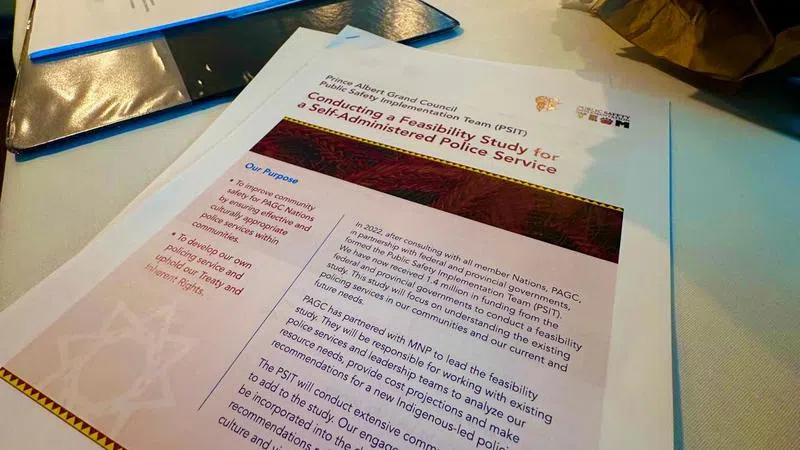
A regional policing study completed by the the Prince Albert Grand Council has been presented to the chiefs and will go next to band councils for review and then be voted on this fall at the annual assembly.  

Vice Chief Josephe Tsannie has been working on the file for a long time and said that some of their 28 communities are already interested in moving forward.  

“I know right now there’s First Nations that are ready, they’ll sign on right away. They’ll send in their band council resolutions and they want to get going right away as soon as possible,” he told paNOW.  

PAGC communities have been policed by the RCMP for over 150 years and decided to explore their own police service almost a decade ago.  

Tsannie said that when they talked to communities about what they need and what their concerns are, they found some common threads. 

The study outlines a lack of 24/7 policing coverage in any of the PAGC communities, chronic staffing shortages, high officer turnover, policing that is reactive, no proactive, delayed response times and a limited capacity to enforce band bylaws and Band Council Resolutions (BCRs).  

It said the issues are systemic, not due to any individual officer failure. In fact, Tsannie said the idea is to work with the RCMP.  

“The RCMP will always be there to partner with. It’s not like we’re washing our hands and getting rid of them. They’ll always be there as a true partner.”    

PAGC communities are facing safety pressures that strain police services even more and traditional policing methods do not address. These are connected to drugs, gangs, addiction, violence, mental health issues, youth crime and domestic violence.  

The proposed model in the study recommends an independent PAGC police board, a chief of police accountable to the board and a cultural advisory council that integrates with policy and operational guidance.  

To operate, they propose a general headquarters to be located in Prince Albert and a regional hub in La Ronge and in Prince Albert.  

Staffing would be tailored to communities using either a hub model, fly-in model, 24/7 road access model or community safety model.  

As far as personnel goes, they suggest that 310 sworn officers would be needed along with 255 civilian staff and modernized or new detachments in every PAGC community.  

Officer housing and secure facilities would be needed in remote communities and communications and IT systems would be needed for the service region.  

The annual operating cost would be about $123 million and a one time amount of $242 million would cover capital costs and money associated with the transition.  

It would take 10 years to phase in the service. The first one or two years would be needed to create the governance formation, arrange funding agreements and recruit a chief. They would also need to develop policies. 

By years three to five, the headquarters and regional hubs would be operational with some staffing in place and detachments under construction.  

In years six to 10, they hope to have full rollout with specialized units in operation.  

PAGC pointed out that while the Chiefs have passed a resolution acknowledging and endorsing the study as a planning document, no decision has been made.

The goal is to use the study to help their member First Nations discuss the idea with federal and provincial partners.

They also stressed that no policing agreement will be supported if it is underfunded or requires communities to inherit a deficit and they want it to meet provincial and RCMP standards.

The deadline for band councils to submit their resolutions is August 24, 2026.

susan.mcneil@pattisonmedia.com