Click here to sign up for our free daily newsletter.
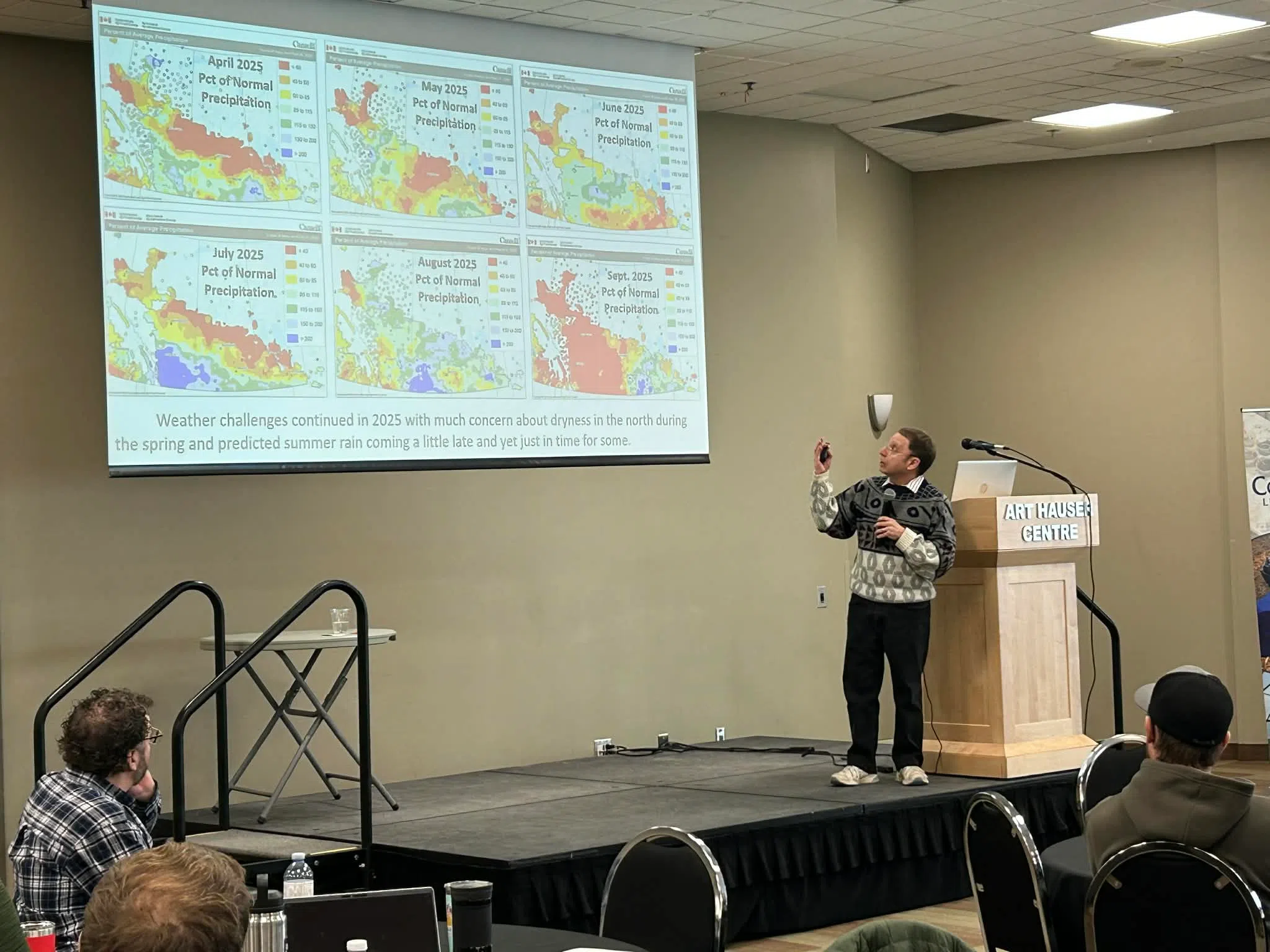
Agricultural Meteorologist at World Weather Inc. Drew Lerner shows off drought conditions around the Prairies from 2025 as he presents in front of the CLC and local farmers. (Image Credit: Nick Nielsen/paNOW Staff)
Many factors leading to unpredictable weather patterns

CLC hosts Crop Talk 2026 with guest Drew Lerner

Feb 12, 2026 | 7:01 AM

The spring seeding season is fast approaching for Saskatchewan farmers, and ahead of that season the Conservation Learning Centre (CLC) just south of Prince Albert hosted their annual Crop Talk event to bring farmers in the area together to talk about trends to watch for the upcoming growing season.

The keynote speaker of the day was president and senior Agricultural Meteorologist at World Weather Inc. Drew Lerner to talk on weather trends.

Robin Lokken is the General Manager at the Conservation Learning Centre, and she believes that bringing in Lerner was responsible for a big increase in the event’s attendance.

“To have Drew join us definitely was a big draw for our event too. We do this annually and usually we get maybe around 40 people registering and so we got up to 90. We’re just so happy that we were able to make it work to have him here and to share that with our local farmers.”


Aside from Lerner speaking about the upcoming weather and what the long term projections are showing. Crop Talk also featured presentations on weed management from Dr. Shaun Sharpe, pests to watch out for in the upcoming year, and a presentation on the projects the CLC is currently working on which Lokken herself presented on.

“So an update on a flax demonstration, growing winter cereals, so winter wheat, fall rye, and then there was also a wheat variety trial that I spoke about. Then we had Allie (Noble) who ran through some pests to watch for as well as diseases, and so the Bertha armyworm were one of the insects that she touched on. They’re on the rise and it was great because she also mentioned that if anyone would like to help with tracking too, that they can reach out to her and get a trap to track numbers.”

As for Drew Lerner’s closing presentation, who is known for having some of the most reliable forecasts from the for agriculture producers to follow and help plan out their inputs for the year. Lerner explained a lot of his process in predicting the weather, but this year is much more difficult than others.

Because of the current ‘La Niña’ conditions, the likelihood that it will switch to ‘El Niño’ mid growing season, years with similar weather a moisture patterns, lingering drought in North America, and other factors in place, the prediction models that Lerner uses are at odds with each other.

“It’s very frustrating because in this particular case, since we have all these different influences, they don’t agree. So it makes it really difficult because the art in being a successful forecaster is being able to meld the patterns together. If you know that El Niño does this and the lunar cycle does that, you put the two patterns together and you come up with a conclusion. But this year, each one seems to have its own anomaly, and it’s making it very difficult to try to put it all together.”

For us here in Saskatchewan, things look favourable for another strong growing year in the province other than the southern portion, which looks to still be dealing with some drought from the last few years. Right now there is a high pressure ridge that has built up from the west coast of North America all the way up to the Arctic, and Lerner believes that cold air will eventually come down south during the early goings of spring.

Lerner believes that cold air will stay east of Saskatchewan, mainly affecting Manitoba, Ontario, and the U.S. That said, Lerner is warning farmers that getting into the field too early this year could potentially be a problem because of some warm temperatures that thaw out the ground, and then that high pressure ridge bringing cold air down would reintroduce frost into the ground.

“If I had to put money on this scenario, I would keep most of the threatening cold in Ontario and across the Great Lakes and down into the eastern United States. So I think we’re probably okay, but yeah, my biggest word of caution to everybody would be that don’t get too far ahead of the normal ‘last frost freeze’ dates until we know for sure that we’re done with this pattern, because this pattern has been very persistent in November, December, and January, same pattern all three months, and it looks like February will end up being that way too.”

While most of North America is still dealing with drought conditions, Lerner said that here in Saskatchewan, and especially up North, moisture conditions are doing better than most other places on the continent.