Click here to sign up for our free daily newsletter.
This upcoming Family Day long weekend is one of two free fishing weekends that the province holds yearly. (Image Credit: ID 4422951 © Tund | Dreamstime.com)
Family Day long weekend

Free fishing weekend prompts reminders of thin ice amid warmer weather

Feb 10, 2026 | 4:20 PM

The province is encouraging residents to trade in their roses for rods and reels this Family Day long weekend.  

One of Saskatchewan’s two free fishing weekends is planned for Feb. 14-16, giving anglers of all ages the chance to fish without a license on all provincial waterbodies. The other free fishing weekend happens from July 11-12. 

“We are lucky to have some of the world’s best fishing right here in Saskatchewan,” Environment Minister Darlene Rowden said in a release. “Free fishing weekend is the perfect chance to get out, explore our beautiful province and enjoy angling with friends, family or your favorite fishing partner.” 

Although it’s free, there are some things that anglers should know.  

For example, anyone planning to take fish out of the province must buy a license; anyone who has a suspended or revoked angling license, or prohibited from obtaining an angling license, is prohibited from angling; and Free Fishing Weekend does not apply to lakes or waterbodies in National Parks. 

Saskatchewan residents looking to take advantage of the weekend are also being urged to keep in mind the warmer temperatures and the risk of thin ice. 

According to the province, nearly 20 per cent of all angling comes during the winter, and fishing during those months comes with its own set of rules. Some of those only apply to all season anglers, but those who plan on casting a line just this weekend have to follow these rules: 

  • Two lines may be used when ice fishing, but they must be within sight and 25 metres (27.3 yards) of the person who set or is using them; 
  • The limits are the same for the ice fishing and open water seasons; 
  • Only gaffs with a J-hook end may be used to land fish while ice fishing, but they cannot exceed 1.5 metres (1.6 yards) long. Use or possession of a spear on ice-covered waters is prohibited; 
  • It is illegal to leave litter on the ice. 

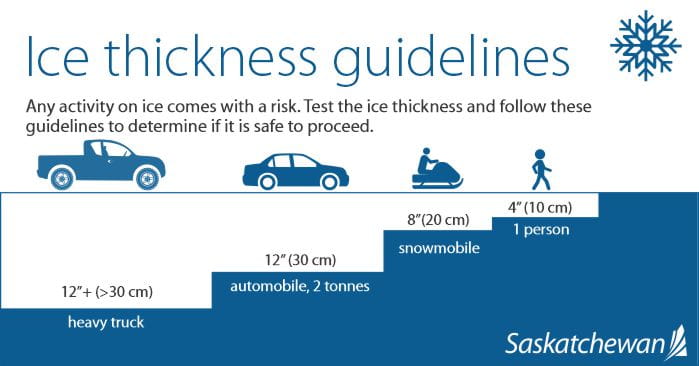
The standard minimum ice thickness to fish in Saskatchewan is four inches, enough to hold the weight of a person. Then, it’s a minimum of eight inches for a snowmobile, 12 inches for a car, and more than a foot thick for a pickup truck or larger vehicle. 


(Image Credit: Government of Saskatchewan)

Jason Matity of getfishing.ca said those are good guidelines, but they’re specifically for the highest quality “black” ice. 

“Anytime it gets sort of opaquey or white, that means snow is melted into it, and it could still be plenty thick underneath,” Matity explained. “But those are signs of ice that isn’t as high a quality as is the clear ice, for example. “All those things kind of combine to deteriorate the quality of the ice. And as the ice deteriorates, it gets weaker, can’t hold up as much weight.” 

He also advises people who are unsure to cut a hole near the edge of the ice to measure its thickness.

“Ice does take a while to form. We had a lot of cold weather to get us to this point, to build a pretty solid layer of ice underneath us. So you’re not going to lose it all in a few days. But that doesn’t mean assume it’s safe. This is why you want to check it always.”

 -with files from 650 CKOM’s Geoff Smith

— 

loganc.lehmann@pattisonmedia.com