Click here to sign up for our free daily newsletter.
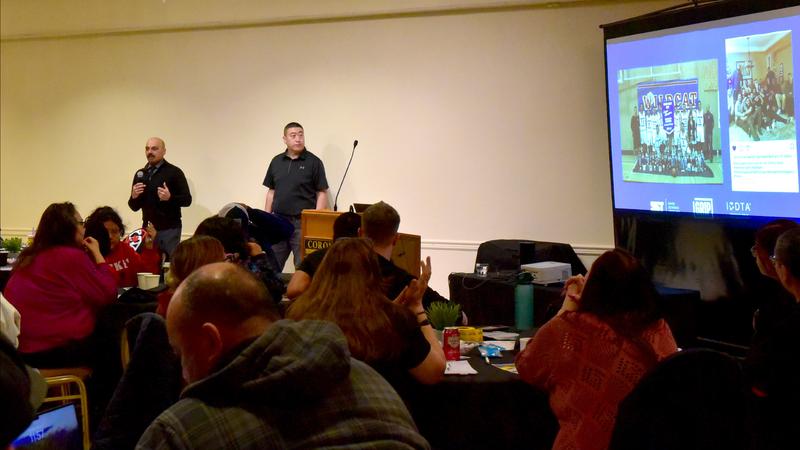
Rob Rai of Safer Schools Together and RCMP Cpl. Jacob Cheung present at a gang prevention symposium at the Coronet Hotel. (Susan McNeil/paNOW)
Gang symposium

Stay connected with teens to keep them out of gangs, symposium learns

Jan 15, 2026 | 5:00 PM

A three-day symposium in Prince Albert’s Coronet Hotel was packed on Day 2, with attendees learning about the risks youth face in modern society and how communities can fight back.

One speaker, Rob Rai, said that despite differences between how teens are pulled into gangs in Langley, BC where he works and northern Saskatchewan, lessons can still be learned.

Rai is part of Safer Schools Together, an initiative that hopes to reduce violence in youth with early intervention, said the idea is that the local community takes what works elsewhere and tailor it for themselves.

“There are parallels here and I think that culture is independent of vulnerability,” he said.

Rai is of South Asian heritage and in his community, most of the at-risk youth are immigrants to Canada.

“What I mean by that is gangs across Canada, previously, there’s been some really great work done, but the research has been monolithic in the sense of these are the programs that work, and there was no cultural adaptation or understanding of what these programs needed to do to meet the needs of folks that weren’t second, third, fourth or fifth generation Canadian.”

How a first generation Canadian can be enticed into joining a gang is not identical to how an Indigenous youth might be enticed.

“We had to consider what it meant for Indigenous populations, what it meant for newcomer populations, and what it meant for other populations where culture was being exploited to vulnerability to create foot soldiers and gangs,” Rai said.

Fortunately, people exists that do know and that is community, including schools and parents or any caregiver, that is around the youth.

“Without a doubt, you are the local expert in the sense of you know your vulnerable kids the best,” he said.

The SST initiative partners with professional sports teams. In BC, that is the Lions and the Vancouver Canucks and having them be part of the work has proven to help young males especially.

“One of the things the research tells us says that young males are still trying to find themselves in that identity and between the ages of 14 to their early 20s, they really engage in risk-taking behaviour because they really want that adrenaline rush, that real feeling of risk-taking,” Rai explained.

“If we can take the risk-taking and put it into a structure, organized program as opposed to running in the streets, young men are going to engage.”

The Langley youth that Rai works with are happy to go skating with the Canucks and get free hockey sticks, despite the fact they haven’t been in Canada that long.

“When we started doing football with the BC Lions or we started doing the Canucks programming where kids were allowed to come out and play sports and really, really burn off that extra energy, belong to a team, have identity based on clothing and a brand, we found that were able to re-direct them from some of the risk-taking they were engaging in the community outside of school,” he said.

Looking back at his own youth, he can see the impact that having an adult take a sincere interest in him and encouraging him made a difference. Some of his old friends are not alive anymore and he wonders where he would be without positive influences.

“Sometimes I wonder if I’d made poor choices, made poor choices at the wrong time at critical junctures, I might have gone a different way,” he said.

Social media means kids are much more accessible to each other and also to negative influences so that means working harder to redirect them in good ways.

The best advice Rai can give parents and caregivers is that their teens need a connection with adults in their lives and will find a way to get it whether positive or not.

“Keep doing what you’re doing, continue being a loving parent. We know you’re doing great work and in moments where you’re feeling stressed, know that your kid needs your time – not your physical time – but your emotional attachment,” he said.

One guy he knows who became involved in gangs was from a very affluent family but told him that while his parents had time to save the whales, they didn’t have time to save him.

The symposium concludes on Friday with a movie and question and answer period.

susan.mcneil@pattisonmedia.com