Click here to sign up for our free daily newsletter.
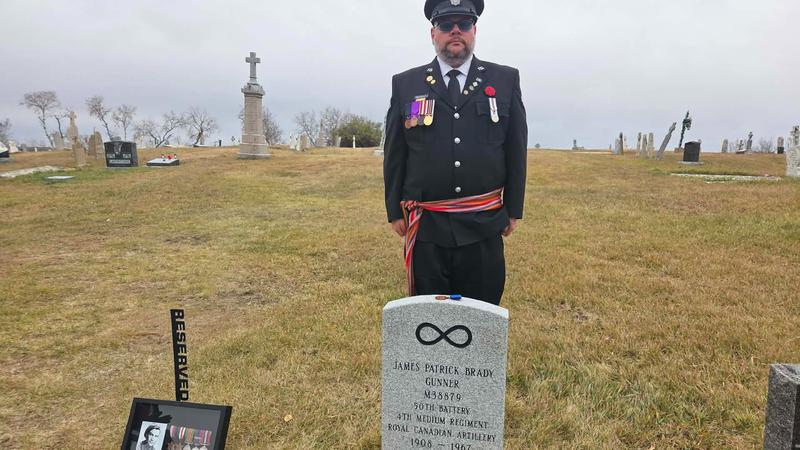
John Brady McDonald, wearing his firefighter uniform, stands at attention behind his grandfather Jim Brady's cenotaph at Batoche. (submitted/J. McDonald)
Remembrance Day

Sask Métis leader and WWII veteran now has memorial stone at Batoche

Nov 8, 2025 | 7:00 AM

The Métis grandfather of a Prince Albert man who hated Nazism so fiercely that he not only signed up to fight in WWII, he also fought the government for the right to join in the first place.

Jim Brady was initially denied entry into the Armed Forces because he was considered a communist, but after persisting, he was accepted in June 1943.

John Brady McDonald, Jim’s grandson, never met his historic grandfather, but has spent a lot of time learning about him.

“He wanted to fight because he was such a strident and strong anti-fascist. He despised Nazism. He despised Hitler,” said McDonald. “He knew from what he could see, the horrors that fascism was bringing to Europe.”

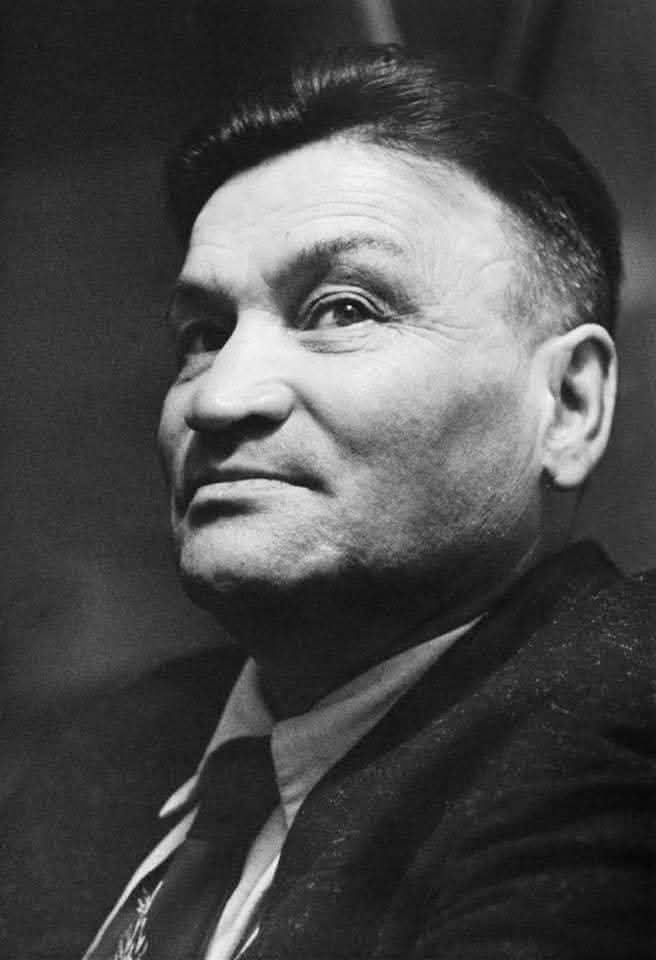
“They actually refused to let him serve, and he had to fight to get in to fight.”

Jim Brady. (photo credit Glenbow Archives)

Brady enlisted as a gunner in the Royal Canadian Artillery and saw action in France, Belgium and the Netherlands. He was also in Germany before returning to Canada the year after the war ended.

John Brady was not just a fighter in a global conflict, though he became a well-known figure to Métis people in Saskatchewan and Alberta for leading the groups into some uncharted waters.

Brady was a founding member of both the Métis Nation of Alberta and Métis Nation – Saskatchewan. He grew up in Alberta but moved to northern Saskatchewan after his military service ended.

That’s why his family went through the effort of having a headstone cenotaph installed at Batoche, 50 km south of Prince Albert, and now a national historic site, but home to Saskatchewan’s Métis people since 1884.

“My grandfather, Jim Brady, is one of the most well-known, greatest and is considered one of the greatest Métis leaders in Canadian history,” McDonald explained.

Brady kept a diary of his military service in Europe, which now sits at the Glenbow Museum and Archive in Calgary, and is still studied by military historians to this day.

He spent his working career as a conservation officer for the Department of Natural Resources. He lived in Deschambault Lake, Cumberland House and La Ronge.

Brady’s body isn’t under the cenotaph nor is it in a graveyard.

It’s believed to be at the bottom of Lower Foster Lake, further north, after he went missing in June 1967, along with Absolum Halkett from La Ronge. The circumstances were mysterious, according to his grandson and the Canadian Encyclopedia, which has a lengthy article on his life.

An extensive search of the lake did not result in any success. The men were gone, but their camp remained at the shore along with their canoes in the water.

If and when his body is recovered, his family plans to lay him to rest in Batoche.

“There were many options open for us to have a memorial headstone for him,” McDonald said. Brady made his mark across western Canada, but McDonald said one of his aunts summed it up best when she said he belongs at Batoche because he belongs to the Métis Nation.

Like many families, military service is not limited to one member.

McDonald had two great uncles who were in WWI and fought at Vimy Ridge, one of whom died in the battle. His remains were never found and are still there. The other uncle was given a medal and later became one of the founding members of the Federation of Sovereign Indigenous Nations (FSIN).

The Mistawasis Nêhiyawak community sent 18 of their young men off to war, including his cousin Harvey Dreaver.

Historians believe the Dreaver was the first Indigenous soldier and a Sergeant with the Regina Rifles to land on Juno Beach on D-Day. He was killed in action in October 1944 during the Battle of the Leopold Canal.

Another great uncle fought in Operation Husky, the invasion of Sicily in 1943 and was wounded.

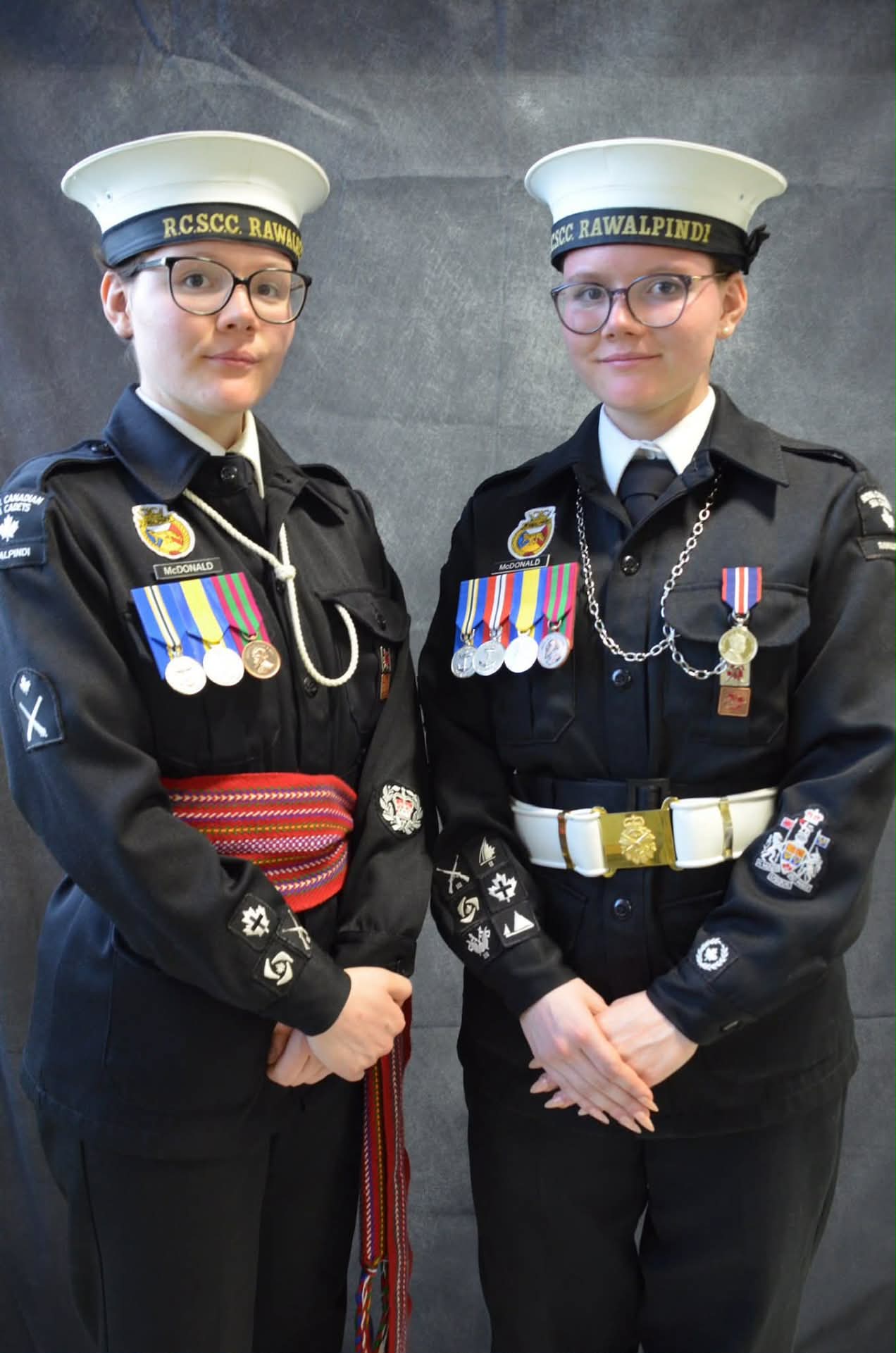
Two of McDonald’s triplet daughters have gone through the cadet program and he is a civilian instructor.

One of those daughters is now one of the highest-ranked cadets in Canada, and another is in the Raven Program, ranked as a Seaman Third Class in the Royal Canadian Navy.

6. Chief Petty Officer 1st Class Lydia McDonald (right) and Chief Petty Officer 2nd Class Nesslin McDonald (left), Royal Canadian Sea Cadet Corps 118 Rawalpindi, 2025 (photo credit OCdt Tianna Stewart)

“The work they do through the cadet program and through the Raven program is amazing, and I’m very, very proud of what they’ve done and what they’ve achieved.”

McDonald’s step-grandfather from Muskoday Cree Nation was in the Royal Canadian Engineers, signing up as a 40-year-old and helping liberate a concentration camp after also being part of the Juno Beach landing.

Canada will celebrate Remembrance Day on November 11 and Indigenous Veterans Day on Saturday, November 8.

Near Prince Albert, Beardy’s and Okemasis Cree Nation will begin their ceremony at 9 am. It will include a roll call, honour song, flag raising, wreath laying, a victory song and a Royal Canadian Air Force flyby at 11 am.

The day’s events will end with breakfast at The Grill at the Willow Cree Arena.

susan.mcneil@pattisonmedia.com