Click here to sign up for our free daily newsletter.
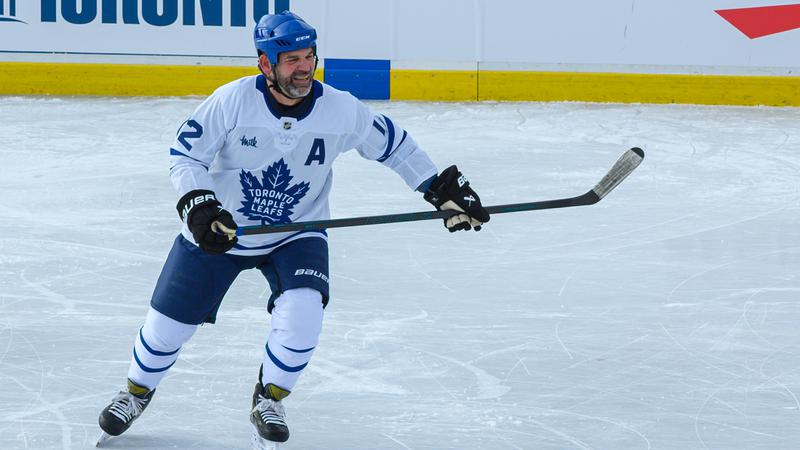
Clark during a Toronto Maple Leafs alumni game. (ID 357561662 © InformaPlus | Dreamstime.com)
Saskatchewan's last #1 overall pick

Wendel Clark talks Saskatchewan hockey memories ahead of Kinsmen Sportsman’s Dinner

Oct 22, 2025 | 5:33 PM

With the Prince Albert Kinsmen Club’s 16th Annual Sportsman Dinner coming up this Saturday, attendees will not only be there to honour this year’s award winners, but also to listen to stories from Saskatchewan-born Toronto Maple Leafs legend Wendel Clark.

Clark spoke with the paNOW newsroom ahead of the event to share a few stories. Just like the rest of us here in Saskatchewan, Clark found his love for hockey in his local rink in Kelvington while his dad was on the bench coaching their senior hockey team.

“I think senior hockey as a whole was always very big. I can’t remember if it was Tuesday nights or Friday nights [that] were senior hockey night home games in Kelvington, and you’d be watching everybody that was the young farmers or young guys that had finished university or come back to work at home and or some of the midget call-ups playing with the men. So that was kind of the goal of probably every six, eight, 10-year-old growing up in a small town. When I first started watching, my dad was coaching, I think he was done playing, but he was coaching the team at that time.”

Going between his home in Saskatchewan and now in King City, a small town north of Toronto, Clark has noticed a big difference in the hockey culture between the two provinces. Not only did his love for the game come from watching senior games in Kelvington, but in listening to the games broadcast on the radio for some of the local teams.


Clark recalled how, back when he was a kid listening to games, how close and accessible teams in the SJHL felt, like Yorkton and Prince Albert, and how out of reach WHL teams felt.

“We’re pretty lucky out west, they have tier 2 on the radio, where out east here you don’t see it. You’d listen to the Yorkton Terrier and Prince Albert Raider games on the radio, and you’d listen to Saskatoon Blade and Regina Pat games, and they seemed like that was so far, and those players were so good because they were junior, they were past the senior hockey in your hometown. So that made the NHL seem like that’s way too good of players to be at that level. But senior hockey, we could all get to, and the rinks were always full in the small town.”

Clark himself was a member of the Saskatoon Blades for two seasons (1983-84, 1984-85) and was a part of establishing the heated rivalry between the Raiders and Blades when the Raiders first came into the WHL. His older brother Donn was originally a Saskatoon Blade, but in 1982-83, the year the Raiders made the move into the WHL, Donn was traded to the Raiders halfway through his final year.

Wendel remembered the Raiders as one of the weaker teams in the WHL during that first year, but when Wendel made his debut with the Blades the following year, that Raiders team was significantly tougher.

“My brother went from Saskatoon to Prince Albert to play, and then at that time, they were the young expansion team. Saskatoon had a really good team that [first] year, so Saskatoon probably beat them up a little bit early, and then Prince Albert, all those young kids started turning around, and by the time my second year, they’d won it all. So they were not only good, but they were tough, and it was a small barn to play in. It was always a physical game, Terry Simpson always had physical teams and skilled teams, and a sold-out crowd, it always made for a good energy game.”

Wendel’s brother Donn didn’t just play for both the Blades and the Raiders, but he also spent time coaching both teams. Donn was the General Manager of the Raiders from the 2000-01 season until 2007-08, and he was added to the Raiders Wall of Honour in 2019 as a builder. Because of Donn’s health, Wendel came to accept the honours for his brother, and the next day, Donn would pass away.

Even though Wendel never played for the Raiders, he’s proud of the fact that his brother had a lasting impact on the team. With a laugh, Wendel remembered his brother being both proud and frustrated at players he drafted, graduating into the pro leagues sooner than he was ready.

“He loved coaching and managing and all being a part of junior hockey as a whole. I know he really enjoyed his time in Prince Albert and putting teams together. He’d get frustrated, the normal hockey guy putting a team together, then all of a sudden a couple of the kids that you [developed] made the NHL too early and you were hoping to get them back so that you’d be able to make a strong run and in junior hockey, you’d get bad luck and some of the good young players make it because they’re good, but that was the game that you’re in when you’re coaching and managing junior hockey. You’re hoping the best for the kids, but you’d always like them back for their 19-year-old year because then you’re going to be a really good team.”

In the 20 years since the NHL lockout of 2004-05, 15 of the 20 teams that have won the Stanley Cup have had at least one Saskatchewan-born player on their team. Clark credits that to the mental toughness of Saskatchewan hockey players who travel so far to play their games, even in house leagues, and that carries through into the WHL.

“Saskatchewan and Western League as a whole, because of the travel, you really get players that make it, whether they’re the really good players or the role players that end up making the highest level. You get some of your best team players accepting the roles, and that’s what wins in the NHL.”

Clark continued, “I think growing up in Saskatchewan and riding the buses and road trips, you’re learning, but you don’t understand you’re learning the harshness of playing three [games] in four nights, or back to backs, so you’ll learn commitment, and you start playing a lot of games in a row. You have to learn to really play as a team because there’s going to be times when you’re tired, but if you play really well as a team, you can fend off the tiredness and still eke out a win.”

These days, Clark is an ambassador for the Toronto Maple Leafs and can often be seen at games in Toronto. For him, still being able to be a part of an organization that welcomed him and engage with fans is a treat.

Clark will be speaking at the Prince Albert Kinsmen’s 16th Annual Sportsman’s Dinner on Saturday. This year’s award winners are Ian Litzenberger as this year’s Sportsman of the Year, Stryker Zablocki as this year’s Female Athlete of the Year, and Brayden Reiger as this year’s Male Athlete of the Year.

nick.nielsen@pattisonmedia.com