Click here to sign up for our free daily newsletter.
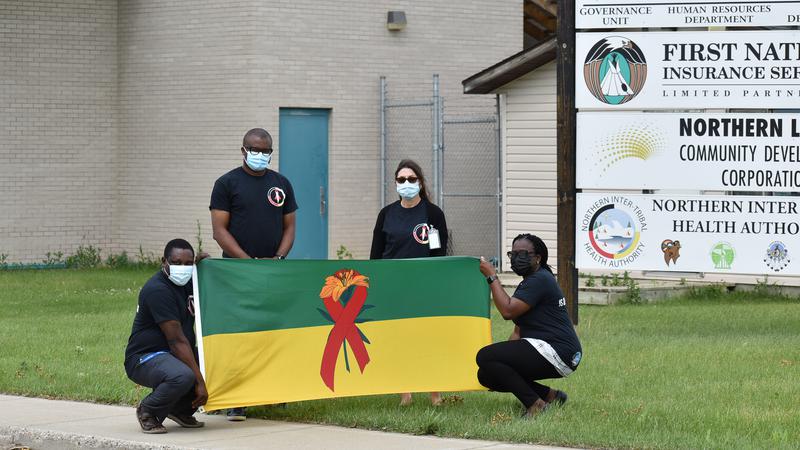
There was a flag raising this afternoon to raise awareness for National HIV Testing Day on June 27. Photographed from left to right are Peter Opoku PAGC HIV coordinator, Dr. Nnamdi Ndubuka NITHA Medical Health Officer, Shirley Woods Director of Health and Social Development PAGC, and Tosin Adebayo NITHA HIV Coordinator. (Submitted photo/NITHA)
National HIV Testing Day

NITHA Medical Health Officer concerned there may be undetected HIV transmission in northern communities

Jun 25, 2021 | 12:00 PM

With National HIV Testing Day right around the corner, the Northern Inter-Tribal Health Authority (NITHA) Medical Health Officer Dr. Nnamdi Ndubuka explained the importance of HIV testing.

He said it’s really important for individuals who have not been tested, especially in the last three months, to get tested. Early detection enables you to seek care, treatment and to prevent further transmission.

“Testing for HIV is also important to prevent an outbreak at the community level,” he said. “And we’re also concerned that there might be undetected transmissions in the community because the individuals are not testing enough.”

He said if no one is getting tested, there is likely ongoing transmission within the community. Without treatment, it increases the chances of transmission which could lead to an outbreak and become even more difficult to manage.


HIV is still a significant challenge in the northern part of the province. Because of the COVID-19 pandemic response, Ndubuka said a significant proportion of resources and efforts have been channeled to dealing with the pandemic. Because of this, many other programs such as HIV testing have been pushed to the back burner.

“Given the rates within our communities, yes it’s still a concern,” he said.

Ndubuka said there has been very limited testing that has been done and this is not unique to HIV. He said now that they’re refocusing their attention, he hopes the testing rates will ramp up again. He’s also hoping those who receive treatment for HIV and go for regular blood work will be able to have more face-to-face interactions that will become more feasible between patients and health care providers.

“Our effort right now is to remind community members about the need to test in order to know the symptoms and then link them early to care,” he said.

In 2019 alone, NITHA had 16 new cases of HIV which is an increase compared to 2018. The rate in northern communities is still 2.6 times higher than the rest of the province in 2019. When they looked at the age group distribution, he said those 32 to 39 years of age accounted for 50 per cent of the new cases reported in 2019.

Despite the COVID-19 pandemic, Ndubuka said they’re constantly reminding the public they should still seek care because people still get sick.

“If anyone needs an HIV test in the community, the services are still there. They can have access to testing,” he said.

In July, the Government of Saskatchewan will be lifting all COVID-19 health protocols and Ndubuka said they hope that will lead to more coming in to be tested for HIV. They anticipate people will gradually seek care and for those to continue to seek care who have been diagnosed.

“Part of the strategy that is put in place right now is to create that awareness for people to understand that as we continue to open the province gradually it’s also time to think about their health and to seek testing for HIV and other diseases that would likely be preventable in terms of early detection, treatment, and care.”

Ian.Gustafson@pattisonmedia.com

On Twitter: @IanGustafson12